


One of the most rewarding experiences in baseball analytics is finding the breakout pitcher ahead of time. I’ve got the projected values and the actual values to dive into.
Top 150 Breakouts
First we go into the top 150 in ADP. These are the pitchers who had big pre-season expectations and went above and beyond.
Breakout #1: Jacob Misiorowski
ADP 120
Projection: 139 IP, 158 SO, 4.06 ERA, 1.26 WHIP
2026 Result: 175 IP, 252 SO, 1.80 ERA, 0.80 WHIP
Misiorowski does not require much deep-diving. He’s a unicorn with a fastball that touched 104 this year and averaged almost 101mph. We knew he could throw that hard, we just didn’t know he’d actually do it almost 1,700 times.
But the biggest difference-maker was the command. After a minor league career with high walk rates and questionable secondary pitches, it seemed to a lot of us like he was destined to be a closer. What was hard to see coming was the 31% Ball% he posted on his heater and the 32% mark overall.
Misiorowski’s 1.64 JA SIERA and 0.80 WHIP are numbers you might not see again. There have been just four seasons below a 0.85 WHIP going back to 2016, when the game started transforming.
2016 Kershaw: 0.72
2026 Misiorowski: 0.80
2019 Verlander: 0.80
2022 Verlander: 0.83
2025 Eovaldi: 0.85
It’s a ridiculous thing to do.
The Lesson: Bet on outlier talent.
Not having a deep pitch mix matters a whole lot less when you’re piping 100mph fastballs with 7.5 foot extension.
The Worry: Injuries.
This will be the conversation for 2027. Misiorowski is likely going to cost you a first round pick, and he’s coming off a year where he threw more triple-digit pitches than (probably) anybody in human history. And he’s not even done yet with their postseason about to begin. Being 6’7’’ is a benefit here, and there’s plenty of room for him to back off a bit next year and still be elite. But early round high-velo pitcher picks are super risky, and Misiorowski is no exception.
Breakout #2: Cam Schlittler
ADP 125
Projection: 131 IP, 131 SO, 3.90 ERA, 1.26 WHIP
2026 Result: 194 IP, 239 SO, 1.95 ERA, 0.92 WHIP
His approach is Misiorowski-esque. Schlittler broke out last year and made a big statement late last year and in the postseason. In 2026, he fired 44% four-seamers, 26% cutters, and 19% sinkers. That’s a whole lot of fastballs. My critique of him was that I didn’t know if he could manage big volume, and I didn’t know if the non-fastballs could carry him.
He averaged 98 on the four-seamer and 95 on the cutter. Throwing a cutter at 95 mph is the more impressive and meaningful velocity signal. Cutters are all the rage these days, and for good reason.
Schlittler posted a 15.2% SwStr% with a 33.1% Ball%. He was in the zone a bunch and throwing a bunch of hard stuff that moved different ways. A hitter could sit “fastball”, but that doesn’t help when there are three options that all move differently.
The Lesson: Bet on velo and fastball variation
A cutter is effectively a slider when you pair it with heavy four-seam usage. And when you’re throwing a cutter this hard (most are in the upper-80s or low-90s), it’s like a super-slider.
The Worry: Injuries.
Same as Misiorowski. The top three at SP next year with Mis, Skubal, and Schlittler. So you’re investing a second-round pick on a guy who will end up adding 60+ innings to his previous season total.
It’s probably not a pick I’ll be advising, but not because I think Schlittler isn’t a top three pitcher in the league.
Bonus Lesson: Mid-Round Upside
It seems that every year we get a few top 10 SP seasons from guys that went after pick 100. There’s a lot less risk you’re taking on in rounds 7-10, so we want to hammer the super-talented and high-stuff guys in that range in the future.
Breakout #3: Gavin Williams
ADP 142
Projection: 163 IP, 166 SO, 3.96 ERA, 1.30 WHIP
2026 Result: 184 IP, 248 SO, 3.76 ERA, 1.11 WHIP
It’s not a coincidence that the top breakout pitchers are still wearing the uniform in October. Williams gave the Guardians 184 innings and 248 strikeouts. He’s been injury-free for a good while now, throwing 168 innings in 2025 and now ready to clear 190 in 2026.
The breakout was facilitated by a big gain in command.
2024: 9.6% BB%
2025: 11.8% BB%
2026: 8.2% BB%
He’s always had a big fastball and a tantalizing breaking ball (the sweeper). But he wasn’t able to put them where he wanted them in the prior years.
His 34% Ball% in 2026 was two points better than the league average, and he ramped up the SwStr% to 16.1% to strike out one-third of the batters he faced.
The difference between Williams and our first two guys is that Williams did not post an elite ERA (3.76). He gave up a high 1.4 HR/9.
45.5% Hard Hit%
11.4% Brl%
24% HR/FB
Some people will take that as a bad sign for 2027. I’m taking it the obvious. K-BB% (he was at 25%) is stickier than what hitters are doing when they’re putting the bat to the ball. We should expect all of those numbers above to drop in 2027. Getting the positive sign of some variance on those fronts should push this ERA into the low-threes or better.
I think the field is sharp enough to not let him slip too far, but I can see Williams being a guy you can get in round four or five.
The Lesson: Bet on stuff and size
Command isn’t random. BB% is pretty sticky year-to-year, but it’s easier to refine command then to add velo and stuff. It’s more surprising to me to see a guy add a bunch of strikeouts than to subtract a lot of walks, if that makes sense.
Gavin is also huge (6’6’’), which is a large advantage in pitching. We need to exercise some discrimination. Shorter pitchers have to do a lot more. Extension is very important, and it’s something we should pay close attention to in pitcher evaluation.
The Worry: Another High HR Rate
I’m not too concerned about this one. Williams is an injury risk as all pitchers are, but he’s been a horse for multiple seasons now, which you can’t say about the other guys. But maybe there’s something to his delivery, pitch mix, and pitch attributes that makes him a little easier to get out of the ballyard. If that repeats, his price will be correct rather than advantageous.
Williams will be a big target for me as my SP1 for next year. He’s coming off of a huge breakout season, and there’s a clear path for him to be even better next year if the HR/FB regressions lower the ERA like I think it can.
Breakout #4: Drew Rasmussen
ADP 140
Projection: 151 IP, 138 SO, 3.62 ERA, 1.15 WHIP
2026 Result: 172 IP, 174 SO, 2.67 ERA, 0.91 WHIP
I’m a numbers guy, and numbers guys hate ERAs. That’s the rule. You have to swear an oath to never say anything positive about the ERA stat when you join this community.
But what was with this projection? His ERAs by year:
2022: 2.84
2023: 2.62
2024: 2.83
2025: 2.76
2026 Projection: 3.62
There are few pitchers that a wise projection system should be projecting under three. I get that part of it, but projecting his ERA almost a full run above what he had done in his career… that doesn’t make a lot of sense.
Rasdaddy has long been one of my favorites, and I’ve been ahead of ADP on him every year. That will probably have to end in 2027 as the discount is going to go away.
Some dudes have things that numbers struggle to quantify. With Drew, it’s soft contact. He’s always had this unique approach of throwing a bunch of his three different fastballs almost perfectly evenly in the distribution:
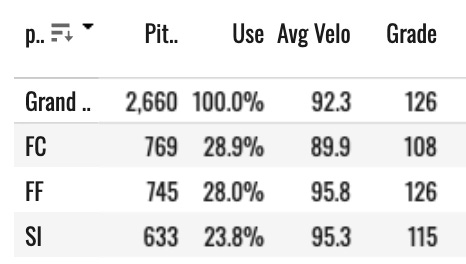
And his command is impeccable. We saw it all come together in 2026, and being as far removed from injury as he’d ever been made everything better.
Lesson: Don’t ignore elite ERA over long-term samples
Some dudes can just do it, man. It’s a high bar to clear before we starting buying into it. Rasmussen doesn’t have high-90s like these other guys, but he has some things a lot of guys don’t, and that’s elite comand and pitch variety year in and year out.
Lesson: Volume can be overrated
150 innings is the next 180. Check out the 75th-percentile innings totals from healthy starting pitchers (pitchers who made 25+ starts in a given year):
2021: 178
2022: 157
2023: 160
2024: 165
2025: 153
2026: 164It came up a little bit this year. Maybe the league is realizing it over-corrected and got too conservative. But the #50 pitcher this year in innings pitched (Tarik Skubal) threw 158 regular season innings.
A 150-inning expectation is a reason to prefer guys with 170+, that’s true, but if you’re filtering out everybody who you think will be limited around 140-160, you’re missing out on some real big potential.
Breakout #5: Dylan Cease
Please consider upgrading to a paid subscription! We’re doing baseball content all offseason long, plus plenty of articles and tools for fantasy football players.