


“All men are created equal” - Thomas Jefferson
“All roto categories are created equal” - Jon Anderson
Leading your fantasy league in WHIP is just as good as leading it in home runs. It is more fun to lead your league in home runs. A replay of a 490-foot cock rocket from your third baseman hits better than a quick 1-2-3 innings with three ground outs from one of your pitchers. But at the end of the season, both categories are equally important.
I think WHIP gets lost in the fold, at least a little bit. I also think it’s one of the easiest pitcher stats to project accurately. These two things give us a potential edge in draft rooms. If we focus on drafting for WHIP, we can easily locate ADP values, and we can feel a bit better about actually getting what we were drafting for.
Making My Case
Allow me to compare WHIP with ERA to make my point. I retrieved some data:
2015 through 2024 SP data
100 innings minimum in a given season to be included
I then narrowed it down to each pitcher that pitched in two consecutive seasons for the purposes of comparing their year one WHIP with their year two WHIP and then their year one ERA with their year two ERA.
My hypothesis was that WHIP would be more sticky/consistent year over year than ERA. Here’s what the data looks like:
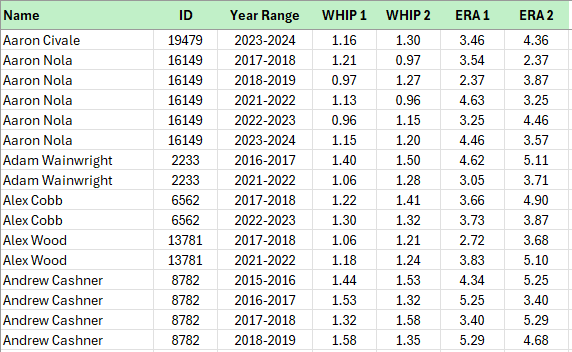
Aaron Nola is a good example there. He’s reached 120+ innings in consecutive seasons five times in this sample. So take a look at the first row there for his name there:

His WHIP moved from 1.21 to 0.97 from 2017 to 2018, while the ERA went from 3.54 to 2.37.
Once we have a bunch of those rows, we can see the correlation for each. Here is the resulting correlation matrix:

The numbers highlighted show you the strength of the correlation between the year two result and the year one result.
What you see here is that neither relationship is strong. A really strong relationship would be shown by a number above 0.7 or so. Anything below 0.3 can be considered not much of a relationship at all, and the relationship moves toward inexistent as you approach zero.
What we see in that matrix is that clearly WHIP is stickier than ERA year over year.
How can we use this knowledge to our advantage? Imagine, for a second, that you have perfect projections that nobody else has. You know exactly what will happen in the coming season. You would win the league every time. We don’t have that and never will, but we can draft better teams by using category projections as optimally as possible. Since WHIP is stickier, the projections will then be better at projecting it. So, if you build a team that projects to be #1 in WHIP and #1 in ERA, you would be more likely to actually be #1 in WHIP than #1 in ERA.
I hope that all makes sense. Let’s extend this intro a bit further by seeing how the projection systems performed last year in these two categories. In this post, I found that ATC was the most accurate projection system in ERA and WHIP last year, so I’ll just use those projections for these purposes.
During the white space right above these words, I have done all of the work. Here’s me showing it:

On average, ATC missed its ERA projections by 17% and its WHIP projections by 10%. That’s a seven-point advantage for WHIP.
Point proven, I hope!
The conclusion is that you’ll be more accurate at getting what you think you’re drafting when you’re drafting for WHIP than if you’re drafting for ERA.
In reality, you should be drafting for both. And it’s pretty much impossible not to. The two stats are correlated together, as you might have seen in the correlation matrix above. The correlation between same-year WHIP and ERA is at 0.84 - a very high number.
There are pitchers that are better at WHIP than ERA, and vice versa - and I’ll tell you why.
The Components of a Low WHIP
Strikeout-to-walk ratio is highly predictive of both. But it’s more predictive of WHIP than it is of ERA.

All of this stuff has the same base reason. ERA looks at more stuff that is out of the pitcher’s control than WHIP does.
A huge component, obviously, of WHIP is the walk. If you walk a hitter, your WHIP goes up every single time. That’s not the case with ERA. You can give up a 3.00 WHIP in an inning and improve your ERA.
I’m just going to keep throwing correlation matrices at you:

BB% vs. ERA: .274
BB% vs. WHIP: .516
K% vs. ERA: -.511
K% vs. WHIP: -.608
They are both more predictive of WHIP than they are of ERA.
That’s the main component. If we stopped there, the only thing I would have to say would be, “Draft high K% and low BB% pitchers to improve your team’s WHIP.” But that would not be worth much, would it? You already knew it!
My main advice at the end of this will be to lean into the low walk rates, but there’s one more angle.
If we look at pitchers with similar K-BB%, we can find a tiebreaker of sorts. The average K-BB% for a pitcher that pitches 120+ innings is 14.6%. I want to compare similar pitchers, so I’m looking at everybody since 2015 with at least 120 innings and a K-BB% between 13% and 18%.
What you’ll find is that high line drive rates are a big problem. This is more “duh” stuff, but if you put a bunch of “duh” stuff together correctly, it becomes a little less “duh”.

To break that down into types.
Batting Average by BB Type
Fly Ball: .250
Ground Ball: .247
Line Drive: .624
Popup: .015
If you find two pitchers with the same K-BB%, you can feel confident that the guy with the lower LD% allowed will have a better WHIP.
The issue is that LD% isn’t sticky year-over-year. However, pitchers with extreme ground ball or fly ball rates are better bets to avoid high line drive rates the following year.
In addition to looking for low walk rates later in the draft, we can also break ties with very high FB% or very low GB%.
This isn’t the case with ERA, by the way. Buying into high GB% is a good way to get lower ERAs. Ground balls never go for homers and, therefore, result in earned runs at a lower rate.
A ground ball and a fly ball are about the same for the purposes of WHIP, though. Just try to avoid the line drive.
The Targets
Now, we actually get to the names we’ll be targeting when attempting to build a realistic pitching staff with a focus on WHIP. We don’t have ATC projections yet because that guy isn’t grinding to the nub in November like I am, so I’ll have to use my own (I was second-best in projecting WHIP, so it’s almost just as good).
The Elite (ADP 1-50)
I do like the strategy of waiting on SP, especially in early drafts, but that doesn’t mean I’m not diving in early to get an anchor. Your WHIP targets in the top 50 of ADP.
Name (ADP/Projected WHIP)
Logan Gilbert (32 / 0.95)
Jacob deGrom (39 / 0.95)
Tarik Skubal (13 / 0.98)
Zack Wheeler (21 / 1.01)
I’d start with one of those guys. deGrom might be the best WHIP pitcher of all time, but I’d rather not put the pressure of being my ace on a guy with such an injury history. There’s much more to say about deGrom this winter, but for now, I’ll say my target with this hypothetical pitching staff build is Logan Gilbert.
ADP 50-100
Bryce Miller (75 / 1.05)
Gerrit Cole (60 / 1.07)
Shota Imanaga (74 / 1.10)
Bailey Ober (86 / 1.10)
Joe Ryan (96 / 1.10)
We get our first Gerrit Cole discount in a very long time, but there are some questions about his trend line. The K% came down, and the BB% came up last year, and he’s well up there in age - so maybe he’s not the safest best.
I do think Bryce Miller is a nice buy here. He’s posted WHIPs of 1.14 and 0.98 in his two MLB seasons, and I do believe he’ll improve as a pitcher in the coming years.
There are plenty of ways to criticize Joe Ryan, but the one thing you can’t knock him on is the K-BB%.

He would be a priority target in a strict WHIP-build.
I’m going to hit a paywall here because I don’t want to give away a bunch of my targets for free! You’ll have to pay me $9/month to get the rest of this post.
ADP 100-150
Sonny Gray (123 / 1.06)
Bryan Woo (125 / 1.06)
Tyler Glasnow (104 / 1.09)
Shane McClanahan (115 / 1.14)
Three Mariners already! It’s like they’re developing pitchers with a focus on throwing fastballs for strikes or something!
Sonny Gray is a target of mine this year in any type of strategy. He has returned a WHIP below 1.15 in each of the last three seasons and took his BB% under 6% last year.
Sonny Gray ERA Indicators
ERA: 3.84
SIERA: 3.03
xFIP: 2.82
ADP 150-200
Nick Pivetta (180 / 1.08)
Bowden Francis (184 / 1.17)
Brandon Pfaadt (166 / 1.19)
I don’t want Bowden Francis for plenty of reasons, but he’s not an awful pick if we’re just trying to bring home WHIP. He has a career 5.5% BB% - and I believe that can stick around next year even if the other stuff goes south.
We also get an “old injured man” discount on Nick Pivetta. It’s a bit risky, but he was at a 29% K% and a 6% BB% last year with a 1.12 WHIP - pretty juicy stuff if he can get and stay healthy.
ADP 200 - 250
Nathan Eovaldi (204 / 1.18)
Yu Darvish (220 / 1.20)
Jeffrey Springs (215 / 1.22)
We aren’t finding many guys projecting below 1.20 here, so we’ll just keep looking for targets under 1.25. Here, we have three old guys who all have workload concerns. I’d probably rather skip this tier, but they are good WHIP arms.
ADP 250 - 300
Drew Rasmussen (276 / 1.05)
Nestor Cortes (271 / 1.20)
Reese Olson (262 / 1.21)
Michael Wacha (275 / 1.21)
Tobias Myers (292 / 1.23)
It would be nice to know what the Rays’ plans are for Rasmussen, but we can use that to our advantage early on because the price is extremely cheap. The guy hasn’t seen the field very much in the last two seasons, but his numbers are insane in his 73 innings (28% K%, 5.8% BB%, 2.70 ERA, 1.06 WHIP). I still believe he’ll get back into the rotation, but at the very least he should be a guy that gets used a bunch out of the bullpen as they build his innings back up.
The Yankees don’t seem to care too much for Nestor Cortes, but he’s in the projected rotation right now and has always been a guy who avoids the walk. He has posted a 1.09 WHIP in his 70 appearances since 2022. As a guy with a lower K% and a crazy high FB% in Yankees Stadium, you probably won’t get a good ERA - but the WHIP is pretty safe.
The four names after Rasmussen are awfully similar. Middling K%, not a lot of ground balls, but reliably low walk rates.
ADP 300 - 350
Cody Bradford (316 / 1.10)
Griffin Jax (319 / 1.13)
Matthew Boyd (350 / 1.19)
Jameson Taillon (320 / 1.23)
DJ Herz (306 / 1.24)
Bradford posted a 4.2% BB% in his 14 MLB appearances last year. He missed a lot of time due to injury but should be back in that Rangers rotation next year.
Griffin Jax also might move to the rotation. He would undergo an approach change, but I’d still feel good about getting a low walk rate and WHIP from him with what we saw out of the bullpen in these last few years (5.4% BB%, 0.87 WHIP last year).
ADP 350+
Shane Bieber (453 / 1.18)
Eury Perez (487 / 1.18)
Max Scherzer (399 / 1.20)
Ben Brown (360 / 1.21)
Tyler Mahle (429 / 1.24)
Braxton Garrett (512 / 1.24)
A trio of guys we don’t think will throw that many innings next year. Bieber and Perez will both be returning from Tommy John surgery, and Scherzer is clearly at the end of his rope - but I do think you’ll get a competitive WHIP from all three in the innings you do get.
Ben Brown is a super unique pitcher. That makes him tough to rely on, but he had a good amount of success in his time last year (29% K%, 8.6% BB%, 1.08 WHIP in 55 innings).
There’s nothing resembling safety this late in a draft, but that doesn’t mean you can’t find reliable, low walk rates in guys like Mahle and Garrett.
Example Staff
It’s early draft season. I’ve been in some Gladiator drafts, which are 15-team leagues where you draft nine pitchers. So, let’s build a hypothetical pitching staff in that format with the current ADP. I’m looking to get three relievers and six starters and to lock in some saves early on. Here’s what we could do:
P1: Logan Gilbert (3rd round)
P2: Edwin Diaz or Mason Miller (4)
P3: Joe Ryan (7)
P4: Ryan Walker (8)
P5: Sonny Gray or Bryan Woo (9)
P6: Nick Pivetta (13)
P7: Michael Wacha (19)
P8: AJ Puk or Justin Martinez (20)
P9: Cody Bradford (21st)
You build that all out and put down the projections, and you end up with a projected 1.09 WHIP and 90 saves.
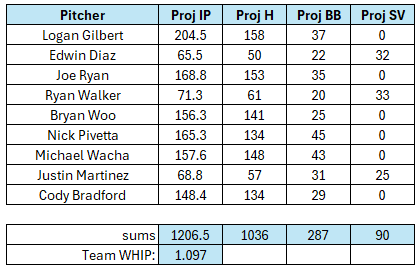
You can also use your 1st, 2nd, 5th, and 6th picks on hitters to get a decent start there.
So there you have it, the WHIP strat 2025!