


MLB DW SUPER DISCOUNT:
I’m offering another sale. New prices:
→ Standard monthly: $9.99/month
→ Standard yearly: $70/year
→ MLB DW Pro: $125/year
And you’ll lock in those rates for next year as well if you subscribe/upgrade this week!
If upgrading from standard paid to PRO, your charge will be prorated so you won’t pay more than the $125 for the year. Reach out with any issues.
I woke up to a text from the Kyle Bradish owner in my league talking about how he was very unlucky last night to have given up 12 hits and he had seven strikeouts and he’s not anywhere near as bad as he looks! Nothing like some cope in the morning!
We do have a resource for that:
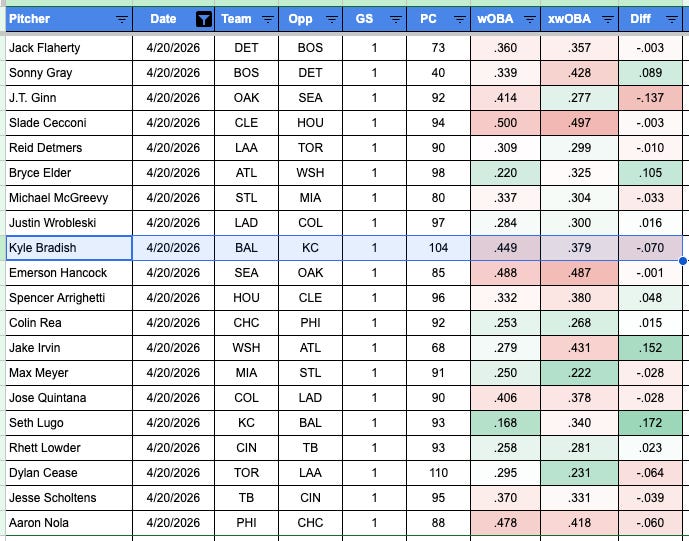
Bradish allowed about a .449 wOBA (the number can be different depending on what exact weights you’re using in your calculation), and a .379 xwOBA. So yeah, that’s a higher actual than expected. But he gave up ten hits, we figured a few of those weren’t hit super hard. The .379 xwOBA is bad, and that’s the more important thing. His 14.4% SwStr% wasn’t bad, but the 39.4% Ball% was.
We can also check the PITCHER LUCK tab on the dashboard to see how Bradish has been in this regard.
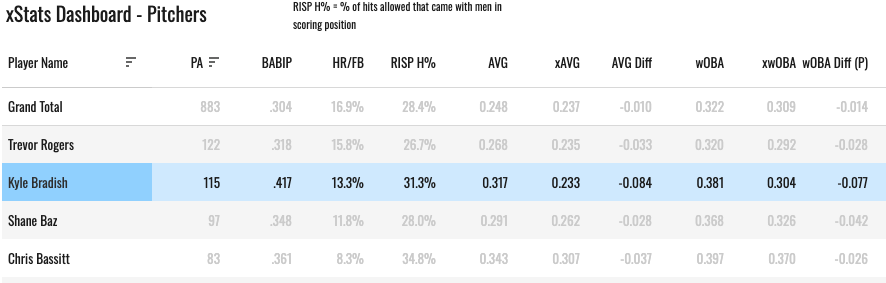
There’s much good news here for the future. His .317 AVG allowed towers above his .233 xBA. In fact, he has the largest differential in the league there:
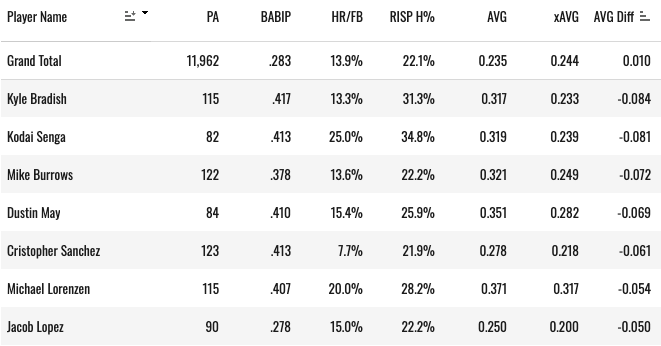
But do you know who doesn’t have a lot of bad luck? Mason Miller! You can’t have bad luck if you never let a ball be put in play. That’s an extreme used to make a larger point.
These are bad numbers:

THESE numbers are unforgivably bad:

His fastballs are so bad. And you just can’t go very far without a decent fastball. I say the same thing every time I talk about Bradish, but how can you get away from it?
I added a new row of tables to the pitcher profiles this morning:

The two on the right side are pretty self-explanatory. These are two are brand new and probably need an explanation:

This classifies each count as neutral, favorable to the pitcher, or favorable to the hitter. Here’s how that classification works, if you’re curious.
IF [balls] = 0 AND [strikes] = 0 THEN "neutral"
ELSEIF [balls] = 0 AND [strikes] = 1 THEN "pitcher"
ELSEIF [balls] = 0 AND [strikes] = 2 THEN "pitcher"
ELSEIF [balls] = 1 AND [strikes] = 0 THEN "neutral"
ELSEIF [balls] = 1 AND [strikes] = 1 THEN "neutral"
ELSEIF [balls] = 1 AND [strikes] = 2 THEN "pitcher"
ELSEIF [balls] = 2 AND [strikes] = 0 THEN "batter"
ELSEIF [balls] = 2 AND [strikes] = 1 THEN "neutral"
ELSEIF [balls] = 2 AND [strikes] = 2 THEN "neutral"
ELSEIF [balls] = 3 AND [strikes] = 0 THEN "batter"
ELSEIF [balls] = 3 AND [strikes] = 1 THEN "batter"
ELSEIF [balls] = 3 AND [strikes] = 2 THEN "neutral"
ELSE "unknown" END
Bradish is throwing 23% of his pitches in counts that favor himself. The league average is 28.5%. If you have a big old fastball that you can hum in there for a strike and not worry about much damage coming even if the hitter is looking for it, you can survive with that. But Bradish being so reliant on breaking balls is only going to thrive if he’s consistently ahead in counts.
But you can’t get ahead in counts with a fastball! A catch-22!
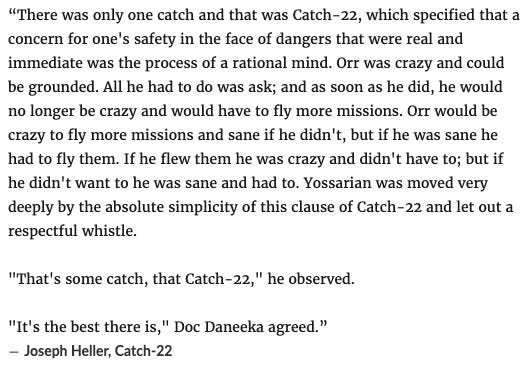
There was like 3-5 year period in my life where I was married and didn’t have kids (or I had one very young kid) and didn’t have this baseball stuff going on, so I had a lot of free time. I read a lot of books in those years. And this Catch 22 book was one of them. It was great. I hope to get back to that someday.
POINT IS, you need a freaking fastball to be good in the Majors. And Bradish doesn’t have one. It was better last year, which is a silver lining. Maybe he can get back to being like 25th percentile bad with the fastball instead of like 5th or whatever he’d be in now, but it’s never going to be a great primary fastball. So the ceiling is very capped. But you certainly can’t sell him for anything now! But you can continue to start him as your SP5-SP6 and you’ll get better results in the future than what you’ve gotten so far.
HIGHEST 0-0 COUNT STRIKE RATES
This will tell us which pitchers are most frequently getting to 0-1 counts, which is a very advantageous thing. And it won’t count balls in play as strikes, because balls in play aren’t freakin’ strikes! If you look at FanGraphs F-STRIKE leaders, you’ll be looking at guys who give up balls in play on the first pitch a lot, and that’s not a good thing.
If you want to look this stat up by yourself at any given time for any given date range, go to the pitchers tab on the main dashboard, set the balls to 0, the strikes to 0, put a minimum pitch count to 100 or so, and then sort by STRIKE%:
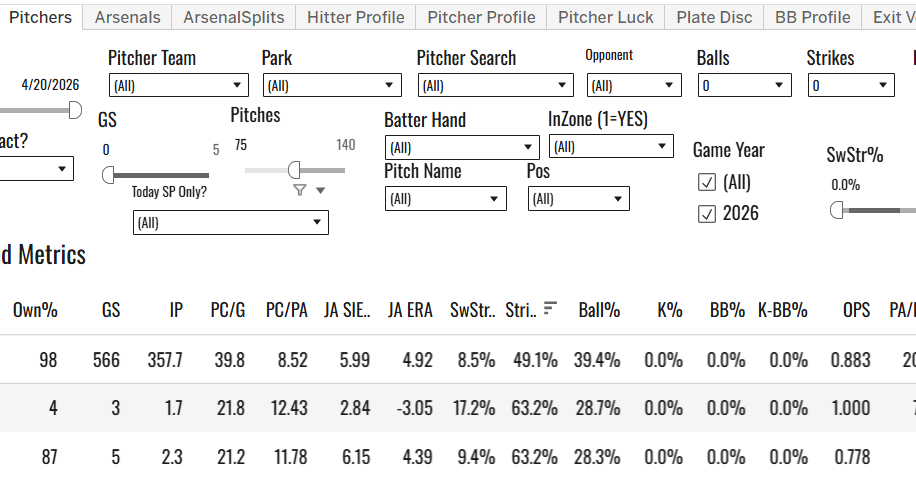
And here are your results:
Chris Paddack 63%
Emerson Hancock 63%
Luis Castillo 62%
Connelly Early 60%
Miles Mikolas 59%
Mick Abel 59%
Anthony Kay 59%
Drew Rasmussen 59%
Sean Burke 59%
German Marquez 59%
The worst:
Jameson Taillon 36%
Kodai Senga 37%
Jacob Lopez 38%
Garrett Crochet 38%
Lance McCullers 38%
Ryan Feltner 39%
Tyler Mahle 40%
Max Fried 40%
Jack Kochanowicz 40%
Brandon Williamson 41%
Max Meyer (5.33IP 3H 2ER 2R 8K 2BB)
I’m just going to leave the point-three-three there, because honestly it’s way more accurate. When Mr. and Mrs. Baseball were coming up with the rules and the stats and how they’d record stuff, they really weren’t too concerned with math. I mean heck, people thought batting average was more important than slugging percentage until like twenty years ago.
But no, Meyer did not throw FIVE POINT ONE innings, that’s ridiculous. He threw FIVE AND A HALF, which is properly denoted at POINT-THREE-THREE (repeating, of course).
Meyer is now at a 15.3% K-BB% with a 3.33 JA ERA and a 3.43 JA SIERA. That’s perfectly fine stuff.
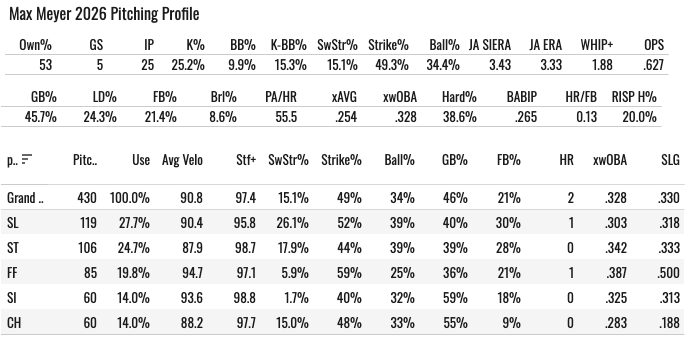
Meyer has been WAY ahead of dudes:

The slider is the money pitch, and it always has been. But we’re seeing that big time this year with a 26.1% SwStr%, a 52% Strike%, and a .303 xwOBA. He throws a sweeer behind it, and that’s been fine.
His fastball has never been good. So far, he’s put up an elite 59% Strike% with it, but that’s really tough to believe in for the long haul because of the lack of whiffs (5.9% SwStr%). That is a Strike% to SwStr% gap I’m not sure I’ve ever seen. The Stuff+ model doesn’t like his fastball either (97.1), and we have a history of it being bad. So I think it’s going to be bad, and he’ll be held back by that.
Bradish and Meyer are both pretty similar. At least Bradish has had extended dominant runs, while Meyer really hasn’t. He’s had some big moments and plenty of nice individual outings, but he’s never consistently put it together.
I’d say he’s a must-own in 15-teamers, and a decent 12-team option. The breaks are really good, and he’s throwing enough strikes so far.
Reid Detmers (6.0IP 5H 4ER 4R 5K 2BB)
It wasn’t a disaster, and it was a tough matchup with Toronto who is still the toughest lineup in the league to strike out. The 13.3% SwStr% and 34.4% Ball% were fine. Detmers still sits here with a 19.2% K-BB% and a 3.03 JA SIERA, so I’d keep starting him if you have him.
One thing to watch for would be workload. I’m not sure how long he can sustain a 102 Stuff+ and a 15% SwStr% since he’s coming off of a year way under 100 innings coming out of the bullpen. I’m not banking on Detmers being very useful in the second part of this season.
Emerson Hancock (5.0IP 7H 3ER 3R 3K 0BB)
Bummer! The good news:
12.9% SwStr%
31.8% Ball%
Zero Walks
We like that. But the fastball got whalloped by the Athletics. He gave up three homers on the pitch. BUT LOOK: a 20.6% SwStr% and a 62% Strike% on the four-seamer. So the strike rate on that four-seamer remains #1 in the league, which is great.
I’ll now give you a timeless truth about baseball that applies to Hancock’s start last night: If he hadn’t given up three home runs, it would have been a great start.
I suppose the problem we might end up with Hancock is the opposite of Bradish/Meyer. The fastball could carry him, but the pitches behind it just might not be enough to capitalize.

So far the majority of whiffs are coming on the fastball, which isn’t common. And he’s not showing confidence in anything but the sweeper, which has been pretty poor with a 53% %ball% and a 12.1% SwStr%. That’s pretty bad news.
And the leash won’t be long, either. Bryce Miller is rehabbing, and Gilbert, Woo, Castillo, and Kirby surely aren’t losing their spot. So they’ll have to either leave Miller in the minors, go to a six man, or boot Hancock from the rotation. Another poor outing or two from Hancock probably ships him to AAA or the bullpen. If you can get something useful for Hancock right now, I’d go ahead and do that.
Seth Lugo (7.0IP 1H 0ER 0R 7K 4BB)
We go through dozens of hours of looking at SPs all offseason to find the breakouts, we look at Stuff+ and advanced metrics and minor league data, and then it turns out the answer to the “Which SP to Draft?” is just SETH LUGO.
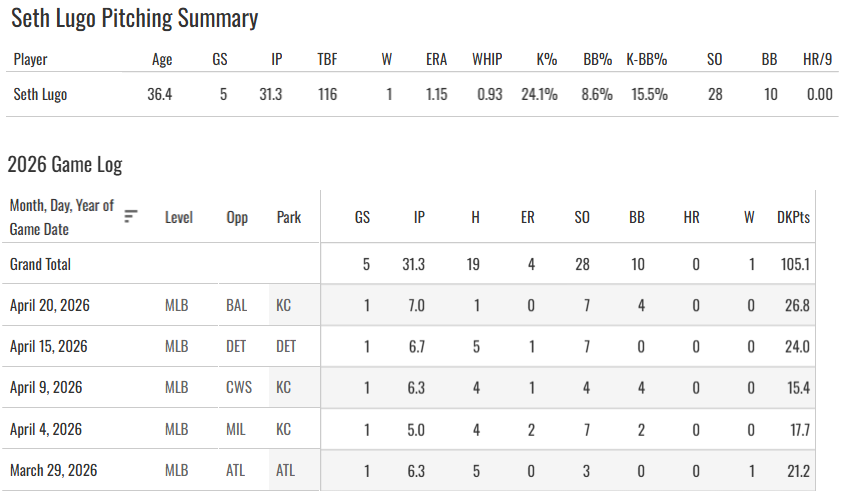
Lugo has allowed just four runs in 31.1 innings (sorry, 31.333333333333) this year, and the strikeout rate isn’t even that bad!

He’s a called strike master, or at least he has been so far. Only one of his pitches has a swinging strike rate above 12% (the cutter at 14% usage), but it’s all working. In these days of 100mph fastballs and short pitch mixes, Lugo has found a new way to go about it.
Lugo was a bit banged up last year, and maybe we ignored that too much. Maybe we thought his 4.15 ERA and 1.29 WHIP were just a sign of age finally getting to him. But if you forgive last year (which I wouldn’t really recommend), he looks like a really good fantasy pitcher:
2023: 23% K%, 6% BB%, 3.57 ERA, 1.20 WHIP
2024: 22% K%, 6% BB%, 3.05 ERA, 1.09 WHIP
2025: 21% K%, 9% BB%, 4.15 ERA, 1.29 WHIP
2026: 24% K%, 8.6% BB%, 1.15 ERA, 0.93 WHIP
I don’t think we’re getting a sub-three ERA, and eventually he’ll give up some dingers with the 27% FB% and the fences being closer to the plate, but the guy can pitch, and a nine-pitch mix cures a lot of potential wounds.
DEEP PITCH MIXES
Number of unique pitch types thrown by pitchers with at least 2 GS this year
9: Seth Lugo
7: Kikuchi, Buehler, Sugano, S Gray, Ohtani, Vasquez, Skenes, McGreevy, Lorenzen, Fried, Liberatore, Senga, Assad, F Griffin, Rea, C Holmes, Paddack, Pfaadt, Painter
And there’s a ton of dudes with six pitches. We can get a feel for arsenal depth by looking at which pitchers have the lowest usage of their most-thrown pitch. Seth Lugo dominates this awith just 21% usage on his most-thrown pitch, which is the sinker. Here’s the top 10:
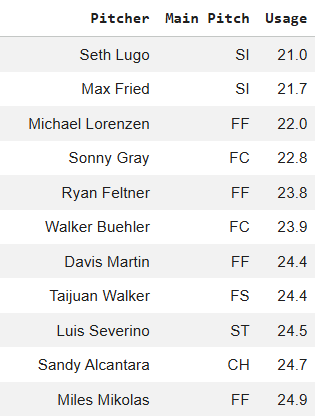
Not a model for success by itself. It can be great (Lugo, Fried), but it also be a sign that a pitcher just doesn’t have a singular good pitch and they’re just kinda throwing the kitchen sink out there hoping it works.
Here’s the other way around, these are the guys most reliant on their favorite pitch:
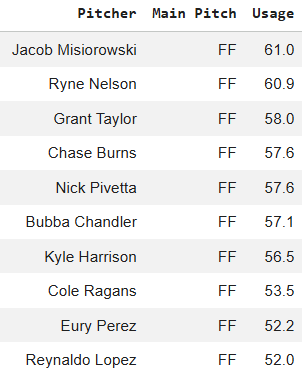
These are all guys with very good fastballs. Except in the case of Reynaldo Lopez and maybe Kyle Harrison (we’ll see).
So this stat doesn’t really have much predictive power. You have to combine high usage with a highly effective pitch for it to work. And usually a widely spread out pitch mix just means that the guy doesn’t have very good stuff in any facet.