

This is part of a post series that John Allen is writing. He had dynasty owners with clunker teams send in the details on their leagues and teams. Below, John offers some advice on how to start righting the ship.
One owner, two different leagues, and three (?) builds.
For the Pimp My Dynasty Team challenge (maybe it was only a challenge for me), I wasn’t expecting that someone would submit two teams. But someone did. And they were so different that I thought this would be an interesting exercise.
Mike sent teams from a 14-team, 10-category rotisserie league and a 16-team, head-to-head categories league with 10 categories. The roto team has been sinking through the years and finished 11th in 2025. The H2H team has been improving and finished 3rd in 2025.
Goals for 2026 are to get back in the chase for the roto league and to bring home a championship in the H2H league.
Before getting to the builds, I was intrigued by the categories.

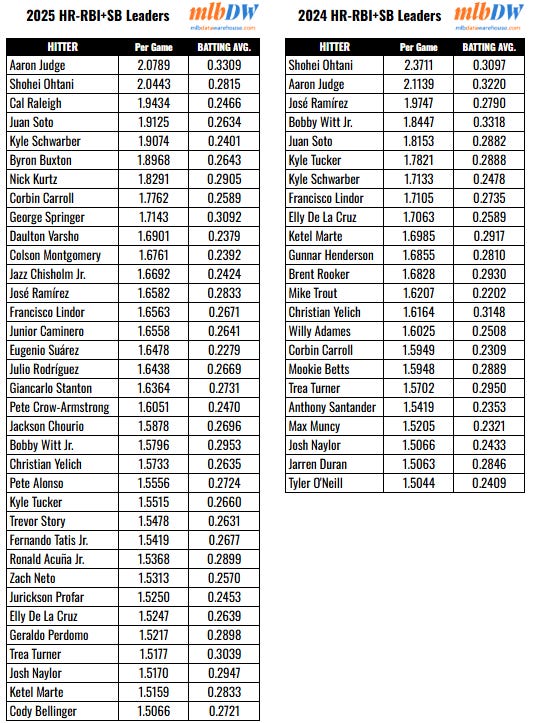
It was difficult to understand how to value the R+RBI category for hitters. So I traveled down the path of what a R+RBI+SB hitter who averaged more than 1.5-point per game looked like over the past two seasons and crossed that with their batting average. I was surprised by how many more fit the benchmark in 2025 compared to 2024.
The biggest difference in the results for the two teams was mostly in the pitching staffs. One was healthy, enjoyed the fruits of a trade that netted Freddy Peralta, among other arms, and had a great mix of starters and relievers. The other was starter-heavy, dealt with a number of injuries, and had poor depth.
But one thing that wasn’t different was the use of minor league pitchers. Each league had 15 minor league openings; only one was used for a pitcher.
Waiting for pitchers to prove themselves worthy of an MLB spot is something Mike was willing to do. And he’s not alone. MLB general managers seem to be doing the same.
In 2021, 180 pitchers made their MLB debuts. Since then, the number has dropped each year – 170 (2022), 164 (2023), 152 (2024), and 143 (2025).
But like buying a ticket in the lottery, you won’t lose your $1 or $5, but you also can’t win if you don’t play. And the Jacob Misiorowski who has been sitting in your minors for a couple years is now going in the Top 100. So it can pay off to take a little bit of risk.
Let’s get into the plans I sent to Mike for 2026.
Roto Team - Hitting
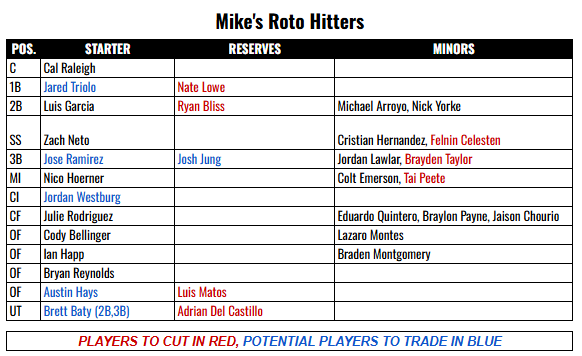
While this team finished 11th, it has some stud hitters. Jose Ramirez, Julio Rodriguez (key for that must-start CF position), Cal Raleigh, Cody Bellinger, Zach Neto, Jordan Westburg, Ian Happ, and Nico Hoerner are a solid core. But finding a home run-hitting first baseman and a good OBP fifth outfielder would make this offense really sing.
If you wanted to work the trade route, there is a glut of 3B on this roster. Ramirez, Westburg (no longer 2B eligible), Josh Jung, and likely Jordan Lawlar. Shipping one of them out to solve the first base or OF need makes a lot of sense. There has to be another owner with a glut of OF and in need of a 3B.
Among your hitters to get you back to a roster amount to allow you to take advantage of the eight draft picks, this is the order I would release the hitters: Ryan Bliss, Adrian Del Castillo, Luis Matos (unless the Giants shock me and don’t sign a free agent OF), Nate Lowe, and from the minors - Brayden Taylor and Tai Peete or Felnin Celesten (maybe both), and then the minor league guys I included because I don’t see MLB starting role futures.
Since he has no team and no job, I’d also release Austin Hays. But if you drop him, you need to find a starting OF. Which maybe you find in your trade and then you can dump Hays and potentially get an extra pick in the trade.
Roto Team - Pitching
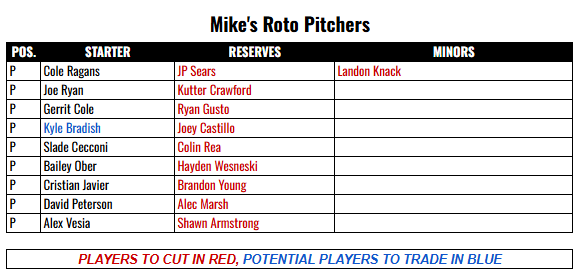
On the pitching side of things, I think you need a major overhaul. Given the categories, middle relievers are going to have more value than normal. They can contribute strongly to four of the five categories (ERA, WHIP, W, SV+Hld-BS). Keeping innings-eating starters on a roster is killing the potential category boost.
My suggestion would be to have a core of 3 SP in the starting lineup each week. Cole Ragans, Joe Ryan, and a hopefully healthy Gerritt Cole would be those three. Then I would look to start 1 or 2 from the following group: Kyle Bradish, Cristian Javier, Slade Cecconi, Bailey Ober, and Kutter Crawford (but he also needs to look healthy in spring training from his secret off-the-field pitching wrist injury). I would prioritize two start weeks and great matchups for those five to earn the lineup spot that week.
But that’s it. Those are your eight starting pitchers for the roster. Unless Cole is going to miss a month or two to start the season. You could keep David Peterson (or maybe JP Sears if he’s in the rotation). But otherwise, those guys are going to be cut. Along with (in order of who to cut first): Alec Marsh, Landon Knack (minors), Ryan Gusto, Hayden Wesneski, Brandon Young, Joey Cantillo, Colin Rea, and Shawn Armstrong.
With your four remaining pitching spots in the lineup, you are going to focus on finding more arms like Alex Vesia. Setup guys on winning teams who could pick up a save every now and then, but will be loading up holds (while hopefully avoiding blown saves), getting occasional wins and helping reduce your ERA and WHIP.
The champion of your league did it the more expensive way with three closers - David Bednar, Edwin Diaz, and Raisel Iglesias. As long as saves and hold count the same, setup guys are easier to find and cheaper to trade for. If you can find someone to deal starters like Peterson, Sears or even Crawford to for good setup guys, I’d do it.
Some of the names that should interest you are: Andrew Kittredge, Garrett Whitlock, Garrett Cleavinger, Edwin Uceta, Griffin Jax, Hunter Gaddis, Shawn Armstrong, Bryan Abreu, Bryan King, Matt Brash, Gabe Spier, Ronny Henriquez, A.J. Minter, Matt Strahm, Phil Maton, Trevor Megill, Jared Koenig, JoJo Romero, Trevor Rogers, and Jeremiah Estrada.
H2H Team - Hitting
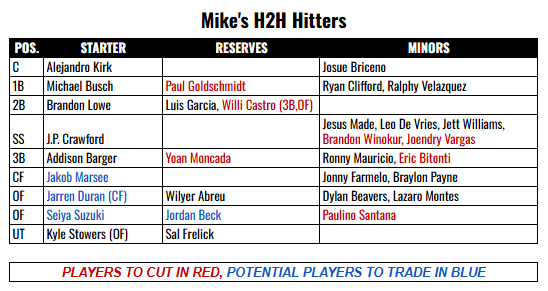
If Jarren Duran could have replicated his 2024 season in 2025, this team could have won your league. Breakouts from Michael Busch, Kyle Stowers, and Wilyer Abreu, plus power surges from Brandon Lowe and Seiya Suzuki boosted your offense.
The total bases category is interesting because it will reward home runs to a point, but all kinds of hits obviously count. So getting more plate appearances by being near the top of the batting order is going to be a bonus. But that bonus is negated somewhat because your league doesn’t count runs.
You need to trim your MLB roster from 34 to 26. With all 15 minor league spots for hitters, I want to trim three to give you a chance to pick up a couple of pitching prospects and a good catching prospect.
MLB hitting cuts would be (in order of who to get rid of first): Yoan Moncada, Adrian Del Castillo, Paul Goldschmidt, and Willi Castro. The minor cuts would be Eric Bitonti, Brandon Winokur, and Paulino Santana. I was high on those guys last year, but they each struggled to hit the ball effectively. With De Vries and Made already your SS prospects, Winokur is just not that interesting for this team.
In the trade market, your roster is swimming in outfield talent. I’m sure you would like to get a little better at catcher (although Kirk getting time at DH makes him more interesting), second base (that was probably the last best season we’ll see from Brandon Lowe), third base (Barger played well, but probably will have a little World Series hangover in 2026), or a top notch starting pitcher.
Among your outfielders, the No. 1 trade in my mind is Suzuki. Great power numbers in 2025 could translate to a sell-high opportunity.
Next on the list is Jakob Marsee. His numbers in his 55-game MLB debut (.292/.363/.478 with 14 SB and 5 HR) were amazing. And 55 games might be enough for most owners to think this is sustainable. If you get a big offer – especially if it can improve two of the positions above – you should consider it, but since he is a centerfielder, it needs to be a very big offer.
Duran is tradable, but I don’t think the market for him will be big. The suppressed 2025 numbers, moving to left field, and solid change he is traded put him in a sell-low category. But if you get a good offer, or you can combo him with Kirk to get a top 5 catcher, or Lowe to get a top 5 2B, or with David Peterson for a No. 1 starter, that would help your overall team. But you also have to believe that Marsee is the real deal because he becomes your CF.
I wouldn’t be looking to move Sal Frelick or Jordan Beck right now. I think Frelick has more in the tank and will be very solid in this league for several seasons. On the other hand, Beck might not. But if he can get off to a hot start in 2026, I think he becomes a good in-season trade chip.
H2H - Pitching
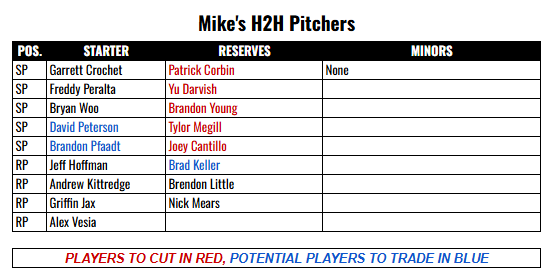
With a locked-in lineup of five starters and four relievers, and scoring categories that include quality starts focusing on starting pitchers who can get you 6+ strikeout-filled innings each time out is key. You have three of those guys already – Garrett Crochet (MLB-best 22 QS and 255 Ks in 2025), Freddy Peralta (only 13 QS but 200+ Ks), and Bryan Woo (21, 198) – without ruining your ERA or WHIP.
Your other starting pitchers – Brandon Pfaadt, Tylor Megill, Yu Darvish, David Peterson, and Patrick Corbin – were sneaky good and bad in 2025.
On the surface, Pfaadt was terrible in 2025. With a 5.25 ERA, a 1.33 WHIP and a career-low 7.49 K/9, there seemingly was no reason to roster Pfaadt. But for the first time in his three MLB seasons, Pfaadt was amazing at home. He had a 3.24 ERA over 97.1 innings, striking out 84 (8.6 K/9). Can that happen again? I don’t think so.
Peterson finished in the top 25 for quality starts (15) and also had 150 Ks but with an unhelpful ERA (4.22) and WHIP (1.37). After putting together a 3.06 ERA in 109 first-half innings, he floundered – with the rest of the Mets – in the 2nd half, posting a 6.34 ERA in 59.2 innings. That second half is part of the reason the Mets are looking for rotation solutions in the offseason. So his 2026 value could plummet into the dropable category.
Megill is the ultimate tease. He is a big power pitcher who can look dominant until he ultimately is injured. You want him rostered in April because this career 4.46 ERA 30-year-old has an ERA of 2.45 ERA in April. But once he breaks – and he has only exceeded 90 innings pitched in a season once in five years, so he is going to break – you can drop him and move on.
Darvish and Corbin are 36+ year-olds without roles in 2026. Darvish had UCL surgery in Oct. and after a surprisingly average season in Texas, Corbin is looking for work.
So if you wanted to drop them all, I might not stop you. Thinking about keeping Peterson, Megill, and Pfaadt would make sense if the league free agent pool is mostly empty. Here are the options in my mind:
OPTION 1 - Kill’em all
Drop Brandon Young, Joey Cantillo, Darvish, Corbin, Pfaadt, Megill, and Peterson because there are better options in the draft, free agency or trades.
OPTION 2 - Hoping and Praying
Drop Brandon Young, Joey Cantillo, Darvish, and Corbin. Keep Megill, Peterson, and/or Pfaadt because they have rotation jobs to start 2026, and there are no good options elsewhere.
Your bullpen is locked and loaded, but has a couple of question marks. Sounds like the Blue Jays would like to move Jeff Hoffman out of the closer role. Since holds count as much as saves, that’s no reason to not keep Hoffman. Is Brad Keller going to be tried as a starter again? It will be up to the Phillies to decide (they have said he’s in the bullpen), but we’ve seen Keller is a good RP and terrible SP.
Griffin Jax is reportedly in the closer committee in Tampa Bay and has SP eligibility (so does Keller), which adds to his value in this league. Andrew Kittredge and Alex Vesia are in the setup/backup closer mix for their teams.