

The New York Mets made one of the most intriguing bullpen additions of the offseason by signing Devin Williams, a two-time Reliever of the Year whose “Airbender” remains one of the most devastating pitches in baseball. It is reported that the deal is for three years at $51 million, including a $6 million signing bonus spread over the three years, with no opt-outs. The move carries risk — Williams’ 2025 season featured inconsistency, command fluctuations, and stretches where he didn’t resemble his dominant Brewers form — but the Mets are betting on stuff, pitch design, and trendlines pointing upward.
Hitters Still Struggled to Do Real Damage
Opposing hitters didn’t handle Williams well, even during his rough patches. Across 177 PA, they hit:
.271 AVG / .305 OBP / .440 SLG / .745 OPS
.169 ISO
35.7% Hard-Hit%
.273 xAVG / .334 xwOBA
The surface slash line looks just OK, but the expected metrics underlined one thing: hitters weren’t squaring him up. He allowed:
7.3% Barrel rate
45% ground-ball rate
Only 13.6% air-pull rate (suppressing home-run danger)
Even when his control wasn’t sharp, Williams still lived in the desirable zone: weak contact, late movement, and hitter frustration.
His 2025 Pitching Profile: Still Packed With Elite Tools
The underlying analytics from the JA model back the idea that Williams’ ceiling is very much intact:

Underlying pitch-mix data:
Changeup (CH) — The “Airbender”
52% usage
83.7 mph average velocity
GB%: 49%
SwStr%: 20.4%
xwOBA allowed: .291
Even after a down season, that changeup remains a weapon.
Four-Seamer (FF)
47% usage
94.1 mph fastball
xwOBA: .271
SwStr%: 16.9%
When command was there, the fastball still played — helped by hitters’ respect (or fear) of the changeup.
Month-by-Month: A Tale of Two Seasons
Williams’ 2025 season was volatile — but it ended the way you’d want a bounce-back candidate to end.

Early Season (March–April): Rough, Spotty, Uncertain
WHIP+ ballooned as high as 4.00
BB% over 15%
SwStr% hovering at 11%
Command and consistency were serious issues. Could not strike guys out.
Mid / Late Season (May–September): Real Rebound
WHIP+ stabilized between 1.24–1.91
Strike% climbed to 50–57%
K% surged to 33–49%
JA ERA dipped to 1.93 at one point
Significantly reduced walks - 0% walk rate in June
This version of Williams — the one who stabilized and struck guys out — is the one the Mets signed.
Fantasy Outlook: Elite Tools, Uncertain Role
From a fantasy perspective, Williams is an aging, volatile, but high-upside reliever — and that contract only adds intrigue. The question is, how will the Mets use him?
Edwin Díaz’s Return Remains Possible
Even with Williams under contract, the Mets could re-sign Díaz, which would push Williams into a setup/committee role and cap his save ceiling.
But Fantasy Managers Are Betting on the Talent
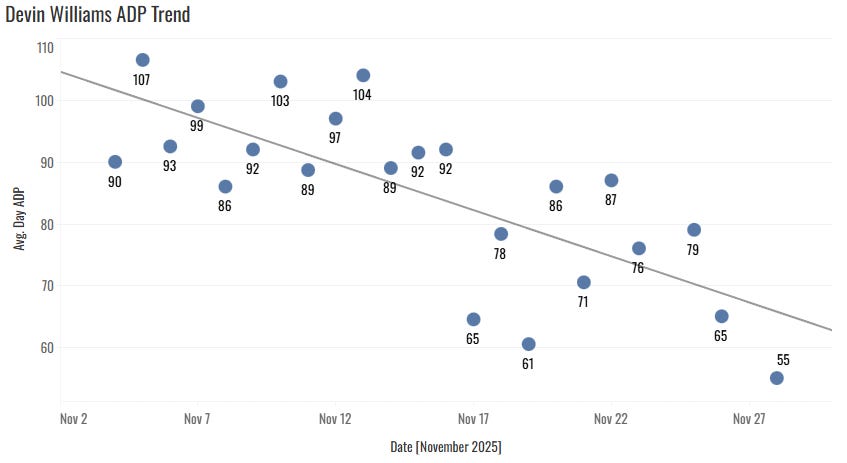
The recent surge in his draft stock shows growing confidence. Managers seem to believe: if the stuff is still elite, the saves will come.
The Risk/Reward Is High
Risk: committee role, limited saves, occasional WHIP spikes if control wavers again.
Reward: dominant strikeouts, late-inning leverage, potential 25–30 saves if he locks the 9th.
In short — Williams is a high-upside, medium-risk pick. In deeper formats or saves + holds formats, he could be a top-10 reliever if things go right.
The Mets’ three-year commitment to Devin Williams shows they believe there’s more in the tank than what his 2025 surface numbers suggest. The stuff remains elite, the expected metrics point toward improvement, and his late-season turnaround offers reason for optimism.
There’s still some uncertainty — from command to how the bullpen roles ultimately shake out — but Williams gives New York a high-upside arm with the potential to stabilize the late innings. If he builds on the progress he showed down the stretch, this signing could provide steady value for the Mets over the next few seasons.