


Rules:
This is fantasy value over real-life value
Hitters are weighted a bit heavier than pitchers, given the added injury risk
Proximity matters, but this is a dynasty-length view
All notes current as of Sunday, August 16, 2026.
26. SP Thomas White (Marlins) - AAA
Previous Rank: 13 ETA: Mid 2027 Comp: A Carlos Rodon arsenal grafted onto Nick Lodolo’s mechanics
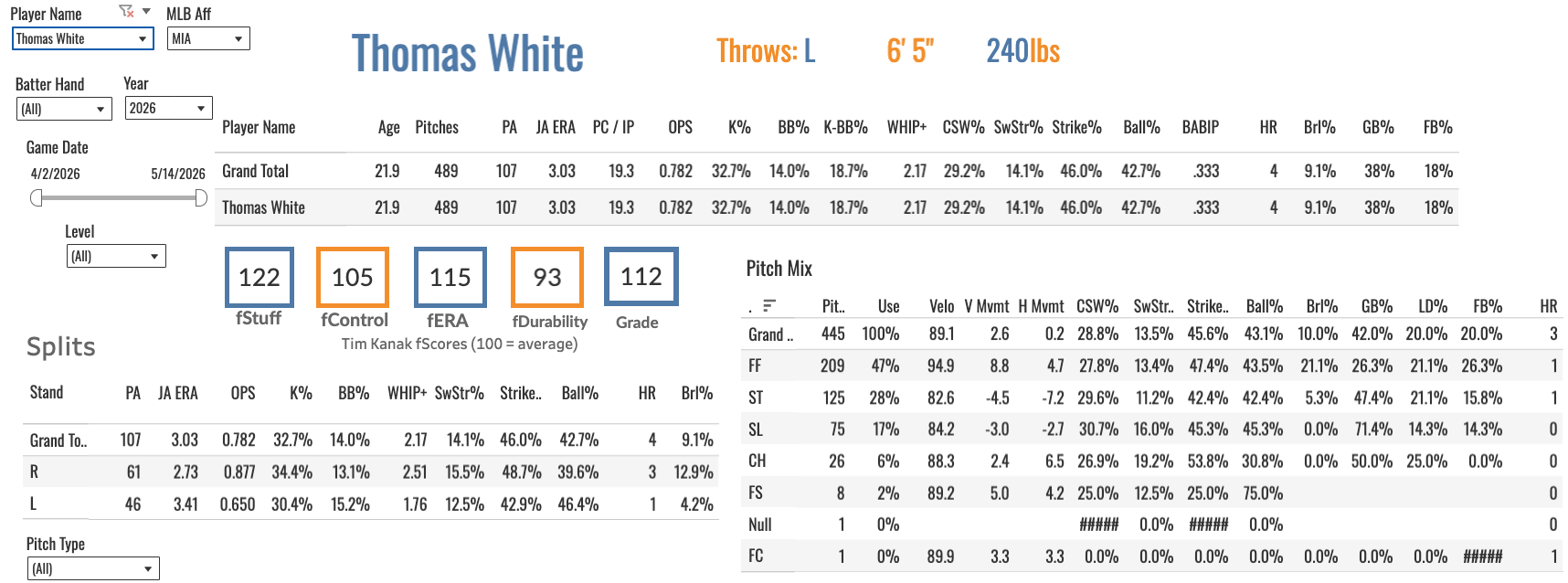
Prime Skills: Watch White’s release point before you watch the radar gun. He works from an under-three-quarters slot, not quite sidearm but close enough to create deception against same-side hitters, and that angle does as much work as the actual stuff. He simplified his breaking-ball mix this year rather than expanding it, he shelved the gyro slider he leaned on in 2025 and returned to his original slurve-shaped slider paired against a true sweeper, and that pitch has quietly become his second-best offering behind the changeup. He debuted a splitter this year too, only eight pitches thrown so far, flashing real swing-and-miss but too erratic to trust yet, and a single cutter attempt got hit for a homer, which explains why he hasn’t gone back to it. The fastball has lost roughly an inch of induced vertical break this year, and his command on it has slipped right alongside that shape change, a real, measurable regression worth tracking rather than a small-sample blip.
Arsenal Grades:
• FA (95-101 mph) w/ run: 60/65
• ST (82-84 mph): 50/60
• SL/slurve (83-85 mph): 55/60
• CH (85-88 mph) w/ sink: 60/65
• FS (88-90 mph): 25/40
• Command: 35/45
Ranking Explanation: Anderson passed White this year on pure in-season dominance, and Hernandez passed him on a cleaner present command grade, even though White’s pure stuff, five pitches with two grading plus, still tops both of theirs on paper. Snelling ranks above him too despite the injury, since Snelling’s fastball still carries more induced ride even in a limited sample. White holds his spot over Rainer and Culpepper below him purely on swing-and-miss upside, neither of those bats projects to be a difference-maker at the plate the way a healthy version of this arsenal projects on the mound.
27. SP Robby Snelling (Marlins) - MLB
Previous Rank: 39 ETA: Debuted, currently recovering from internal brace surgery Comp: A lighter Jesus Luzardo
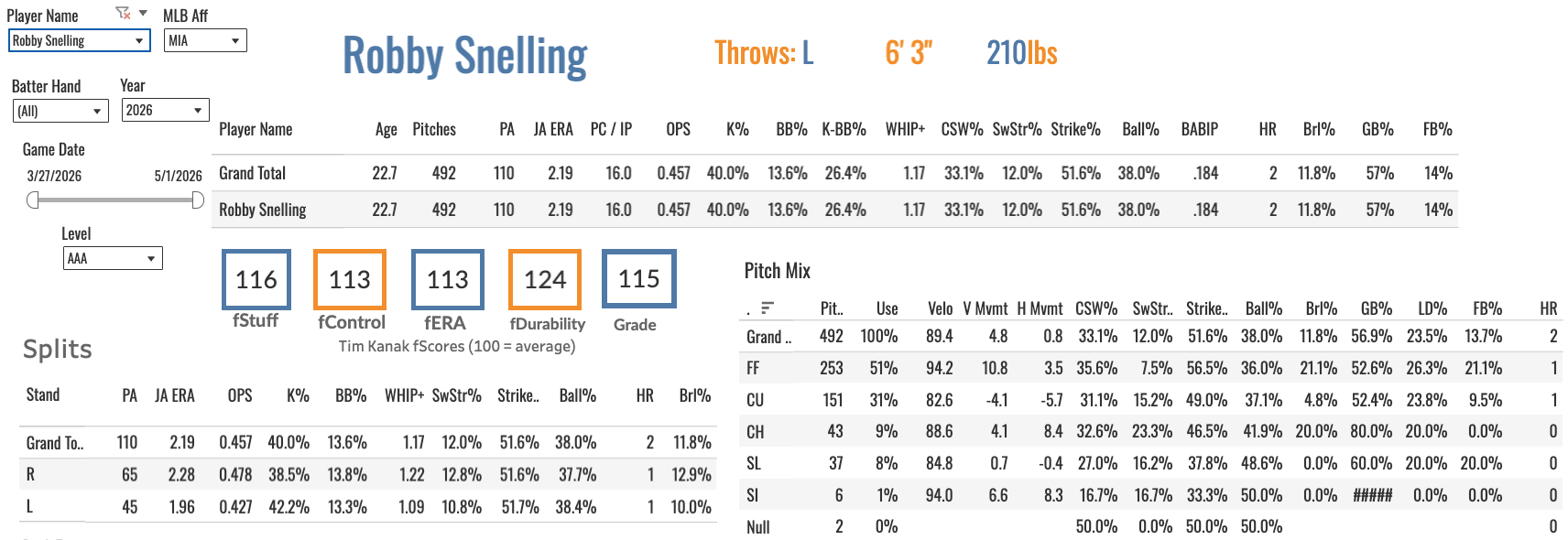
Prime Skills: Snelling throws from a three-quarters slot that creates a nice tunnel between the fastball and slider, and he made a genuine pitch-mix change this year, promoting the sweeping curve into his primary breaker while the changeup ticked up from 86 to 88-89 mph. His fastball climbed from 93 last year to 95-97 this year, real measurable velocity growth rather than a one-start spike, and he added it while dotting the pitch to an over-60% strike rate, an unusual combination of new stuff and maintained command. He generated a swinging-strike rate that climbed into the 20% range this year, mostly off that sweeping curve, which averages around 83 mph. He made his major league debut this year, then needed an internal brace procedure on his elbow immediately after that first start.
Arsenal Grades:
• FA (94-97 mph), high rise: 65/70
• CU (81-84 mph), sweeping curve: 60/65
• CH (88-90 mph), sinking change: 50/60
• SL (82-84 mph): 40/45
• Command: 55/60
Ranking Explanation: Snelling ranks ahead of White above him specifically because his fastball carries more induced ride even in a shorter track record, and the mix change to a real breaking-ball weapon happened faster for him than for White. He drops behind both Anderson and Hernandez purely on the medical file, a 10-to-12-month recovery timeline erases any argument for ranking him ahead of healthy arms with comparable stuff.
28. SS Kaelen Culpepper (Twins) - MLB
Previous Rank: 17 ETA: Debuted Comp: Dansby Swanson
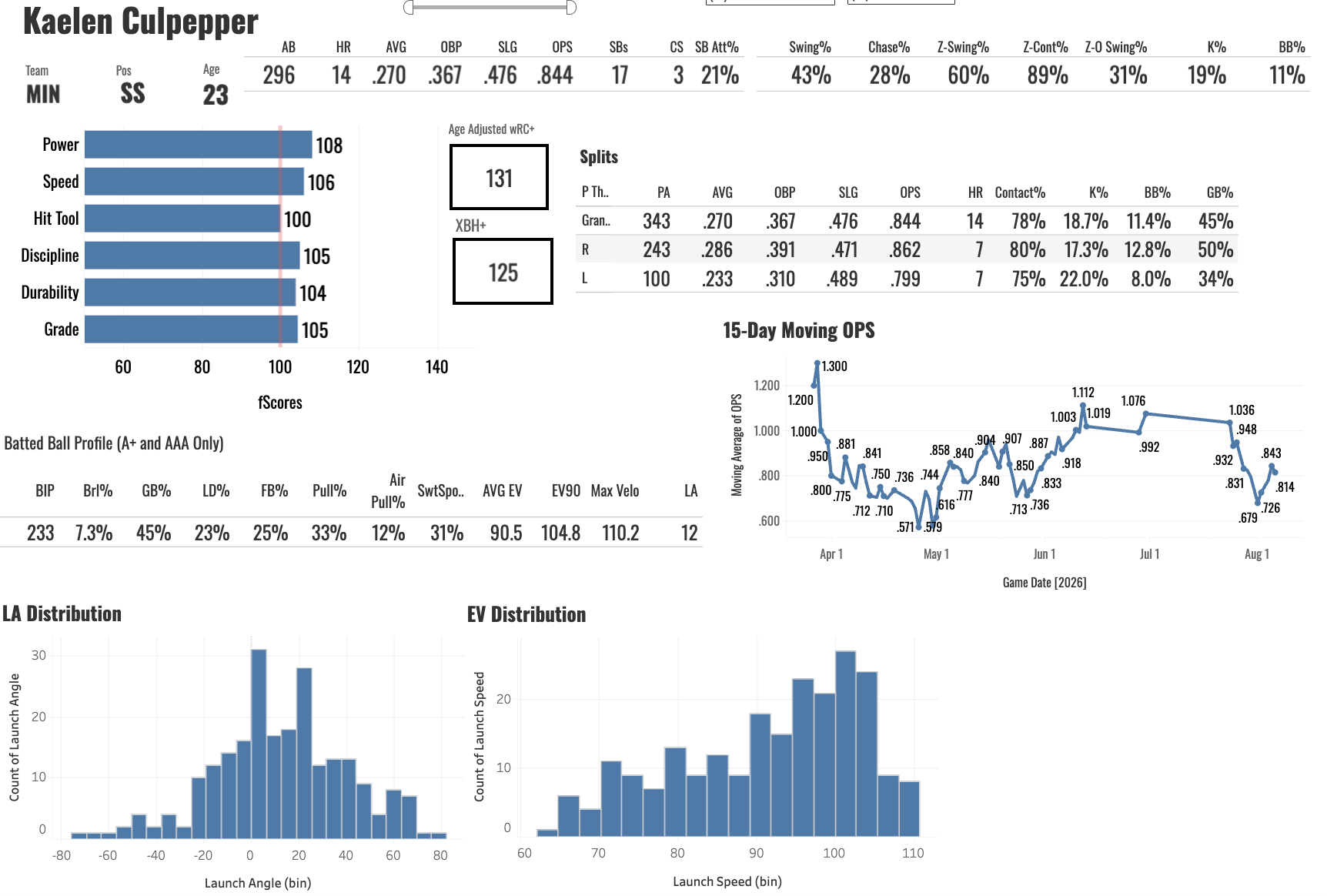
Prime Skills: Culpepper posts a near-elite 89% zone-contact rate this year, up 5 points on his own whiff rate from a year ago, and the swing decisions driving that number matter more than the surface batting average does. His average launch angle has climbed from 10 to 13 degrees while his ground-ball rate has fallen toward 45%, a real, deliberate swing-path adjustment rather than incidental variance, and it shows up directly in the power output, 31 extra-base hits in 74 games against 39 across a full 113-game season a year ago. He debuted for Minnesota this year and has struggled early, a 38% strikeout rate against big league arms who are attacking him specifically with breaking stuff, exposing a passivity against in-zone offerings that scouts flagged as a real weakness throughout his minor league career, but it’s a small sample size and he’s good at adjusting. The reverse platoon split that showed up in the minors, better against same-handed pitching than opposite, has carried into that same early big league sample.
Hitter Tool Grades:
• Hit: 50/55
• Plate Approach: 55/60
• Power: 50/55
• Speed: 60/55
Ranking Explanation: Culpepper ranks ahead of Rainer on pure proximity and floor, he’s already accumulating major league at-bats, even rocky ones, while Rainer hasn’t solved his own bat-to-ball problem against any level of pro pitching yet. He sits behind both pitchers atop this tier because an early-career 38% strikeout rate against big league arms is the exact swing-decision flaw scouts warned about finally getting exposed at the highest level, a real red flag rather than simple adjustment noise.
29. C Vahn Lackey (Twins) - A
Previous Rank: null ETA: 2028 Comp: Pudge Rodriguez light and J.T. Realmuto mash
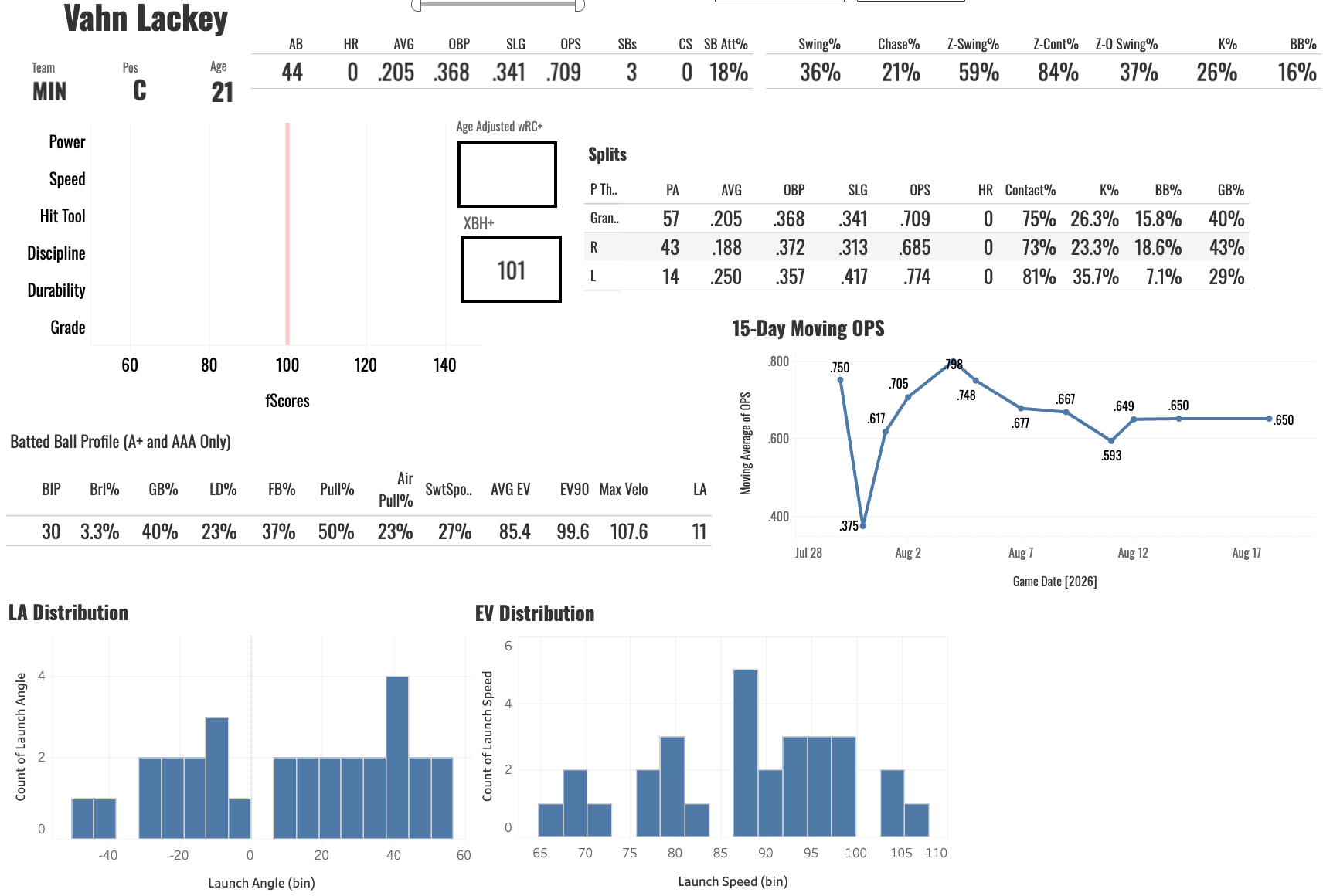
Prime Skills: Lackey became the first catcher Minnesota has taken in the first round since Joe Mauer in 2001, and the underlying data explains why. He posted a 90% zone-contact rate and a chase rate of just 19% in his senior spring at Georgia Tech, elite bat-to-ball skills paired with a genuine refusal to expand the strike zone, backed by a 108.9 mph 90th-percentile exit velocity that came against real ACC weekend-rotation arms, not showcase pitching. He walked more than he struck out for the year, a 17.7% walk rate against a 13.4% strikeout rate, the rare complete offensive season for a college catcher. Evaluators have flagged his receiving and blocking as still-developing rather than finished, which is normal for a bat this advanced at his age.
Hitter Tool Grades:
• Hit: 45/60
• Plate Approach: 45/60
• Power: 45/60
• Speed: 60/55
Ranking Explanation: Lackey ranks below Culpepper and the two arms above him purely on total distance from the majors and even an excellent college catcher’s defensive projection carries more real variance at this stage than an infielder’s or outfielder’s does. Catchers will generally move slower than other position players due to all of the defensive and game calling responsibilities, but I do expect him to move quicker than most. He ranks ahead of Hartshorn and everyone below him in this tier because the offensive foundation alone, zone-contact and chase rate both already elite against high-level college pitching, is safer than any bat further down this list.