


Rules:
This is fantasy value over real-life value
Hitters are weighted a bit heavier than pitchers, given the added injury risk
Proximity matters, but this is a dynasty-length view
All notes current as of Sunday, August 16, 2026.
1. SS Jesus Made (Brewers) - AA
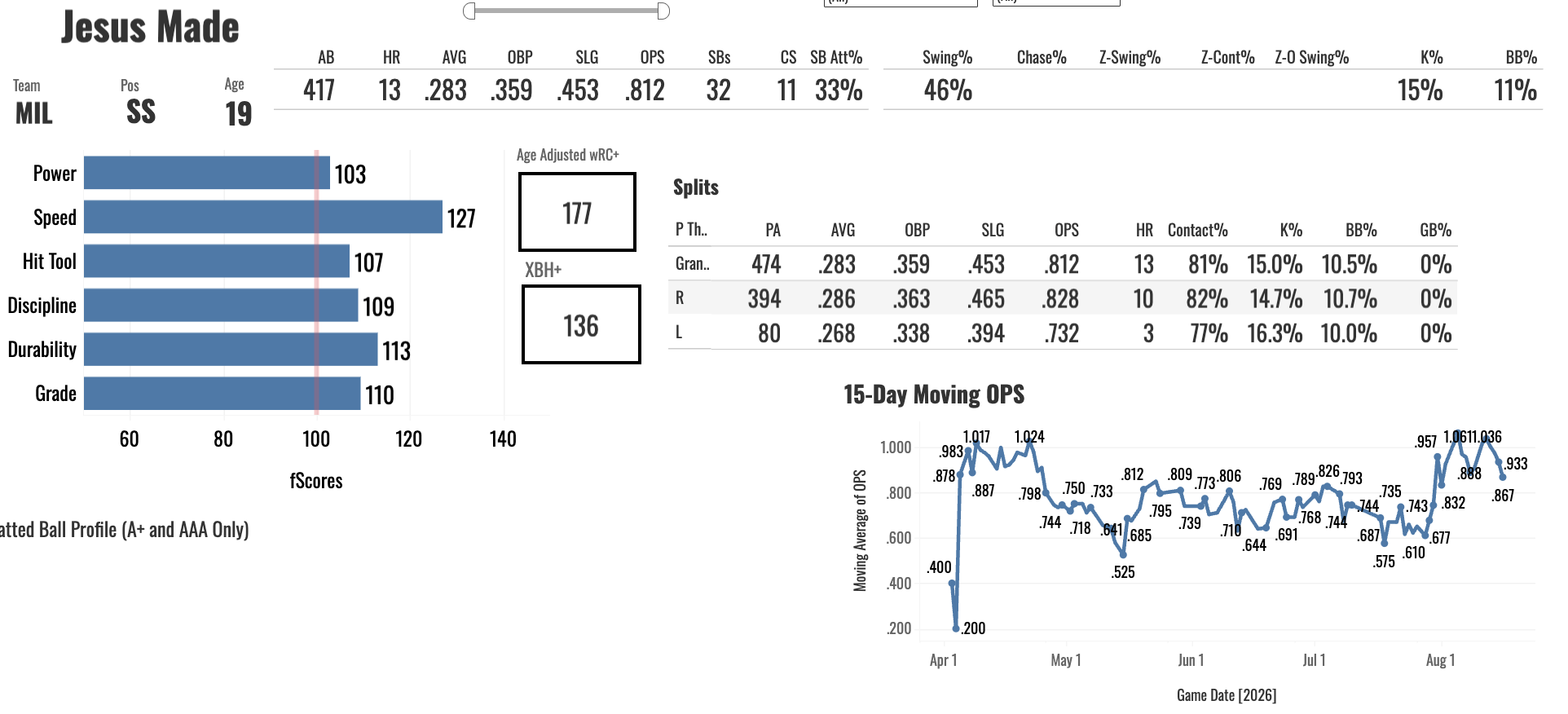
Previous Rank: 1 ETA: Mid 2027 Comp: A smaller, switch-hitting infield version of Christian Yelich, same profile and swing mechanics
Prime Skills: Made is a true switch-hitter with elite bat speed from both sides. Switch hitters doesn’t usually have a symmetrical zone approach, and Made’s isn’t quite symmetrical either, he’s noticeably more pull-conscious righty and stays more all-fields lefty, but the underlying zone-swing rate against pitches he can drive sits comfortably above what you’d want a zero-contact-red-flag guy to run. We have a recorded max EV of 110.9 this spring and an over 106 mph exit velocity in the Future’s Game, but without AAA data we only have a small sample size of recent exit velocity data to pull from for power upside. As of August 16, 2026, he’s up to 39 extra-base hits in 103 games, a rate that’s running well ahead of what an age-adjusted wRC+ model would expect from an 18-year-old in the Southern League, a notoriously pitcher-neutral circuit that doesn’t inflate numbers the way, say, the Pacific Coast League does for West Coast affiliates. What’s still developing is the pull-air rate, he’s spraying a lot of quality contact to the middle of the field rather than consistently getting to the pull-side power alley, and that’s the swing skill separating a great age-relative season from a truly special one.
Hitter Tool Grades:
• Hit: 55/65
• Plate Approach: 55/60
• Power: 50/60
• Speed: 65/65
Ranking Explanation: Made rates as an above-average hitter across every category, with a leaner, twitchier athleticism than the profile his 6-1, 221-pound frame suggests. The separator between him and De Vries is that Made’s hit tool from the right side and overall plate approach play stronger, while he also has a higher power outcome based on body projectability. Peak outcome here is a .280 hitter running 30 homers and 30 steals with a walk rate that keeps the strikeouts limited, that’s not a fantasy archetype, that’s a cheat code, and it’s why he tops a very crowded field at the position.
2. SP Kade Anderson (Mariners) - AA
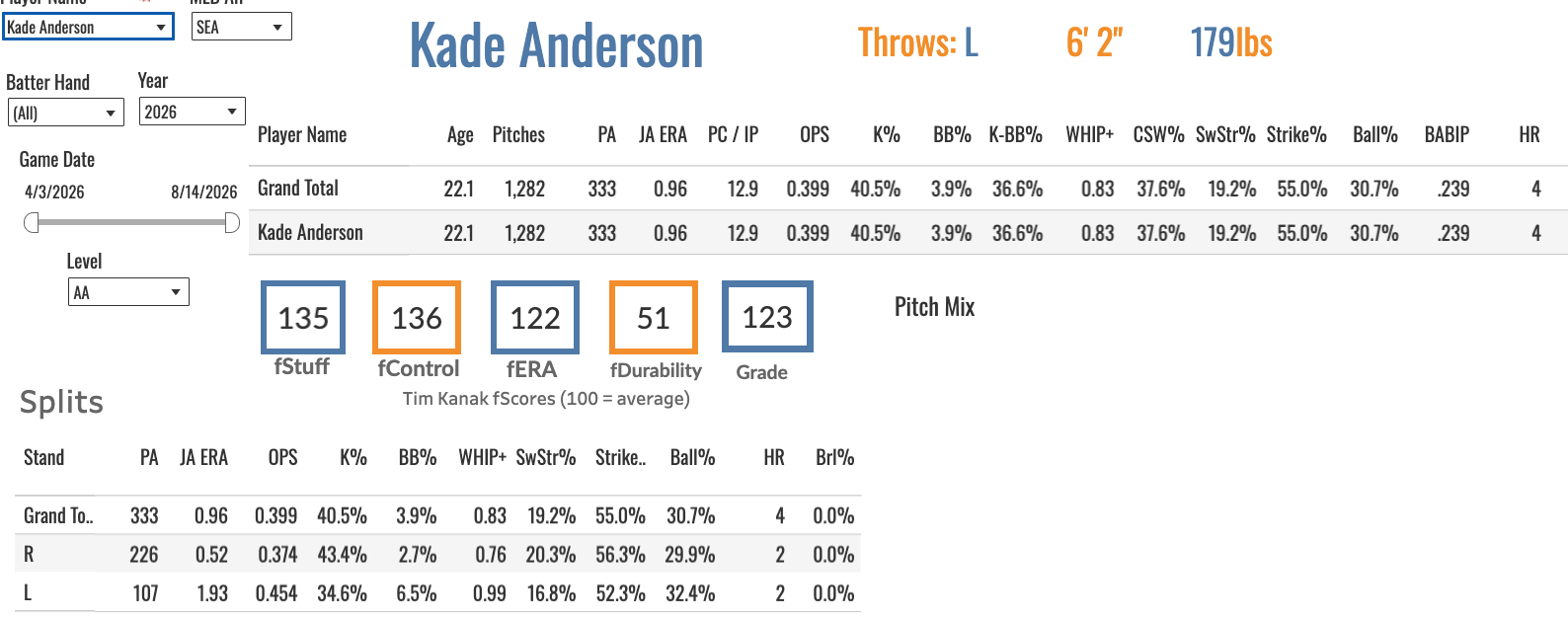
Previous Rank: 4 ETA: Mid/Late 2026 Comp: Max Fried
Prime Skills: Anderson’s fastball shape is the whole argument for why Double-A hitters have looked overmatched. Twenty inches of induced vertical break on a four-seamer is elite in the majors, let alone against A-ball-to-Double-A bats seeing that kind of carry for the first time, and it produced the second-best whiff rate of any fastball in last year’s entire draft class, trailing only Liam Doyle’s. Forget the ERA entirely, that number tells you almost nothing about a college-polished arm skipping straight to Double-A, what matters is a 36.6 K-BB% and a 19.2% swinging-strike rate, both of which belong on a big league leaderboard, not a rookie-year pro debut. That production isn’t just fastball-driven either, the slider and curveball are both generating called strikes at a rate suggesting advanced shape recognition from hitters seeing them for the first time, meaning he’s not relying on one dominant pitch to survive an aggressive assignment. He’s been a revelation with a fantastic 2-plane slider, a nasty diving curve and an improved change up with some nice fade and a newly developed cutter.
Arsenal Grades:
• FA (92-97 mph): 65/65
• SL (84-88 mph): 60/65
• CU (79-81 mph): 55/60
• CH (83-85 mph): 60/60
• FC/SL (87-89 mph): 50/55
• Command: 65/70
Ranking Explanation: I said last update Anderson needed to prove himself against actual competition before climbing further, and the response was less an answer than a rebuttal. He sits behind Made only because pitching prospects, even ones this polished, carry an inherent tail-risk hitters simply don’t, one bad MRI and the whole profile changes overnight. Bats age gracefully into decline; arms sometimes don’t get the chance to age at all.
3. SS Leo De Vries (Athletics) - AA
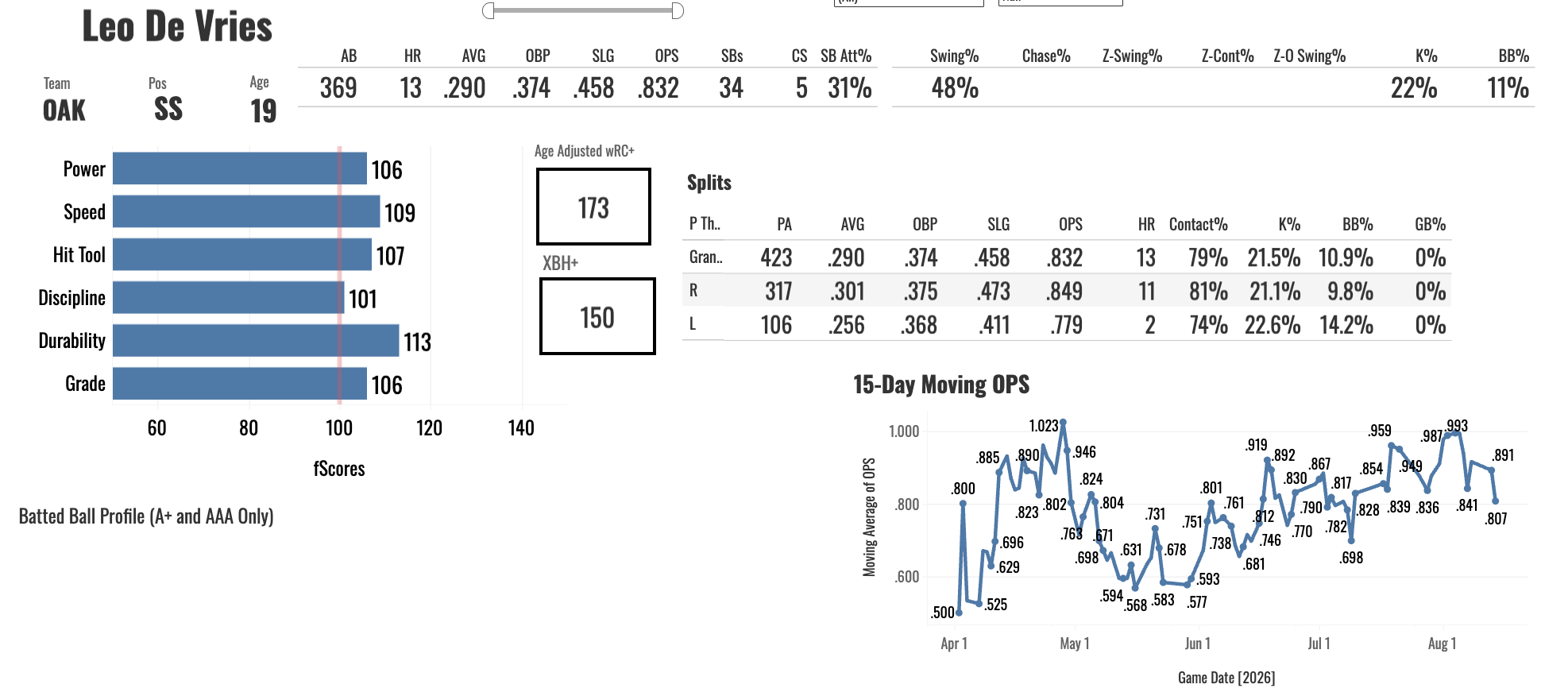
Previous Rank: 3 ETA: Early/Mid 2027 Comp: A switch-hitting Alfonso Soriano at shortstop
Prime Skills: The swing decisions and base running ability are the actual story with De Vries, not the hit tool everyone already knows about. He’s chasing meaningfully less than he did in San Diego’s system, and the specific shape of the improvement matters: he’s not just taking more pitches, he’s getting to better angles on the pitches he does swing at, more line drives and better pull angles since the move to Oakland. That’s a real in-zone quality-of-contact jump, not just a walk-rate story. The concerning number underneath the surface is that his 90th-percentile exit velocity, 103.5 mph, hasn’t moved at all since last year despite him adding good weight, which tells you the strength gains haven’t yet translated into bat speed at the point of contact, an unusual disconnect for a player his age still physically maturing. He’s also been drastically better against right-handed pitching than left-handed for two years running now, a real split worth flagging rather than assuming it evens out with more reps. Additionally the baserunning is much improved and he’s quicker than last season, while also being much more aggressive on the basepaths. De Vries has 35 extra base hits in 93 games thus far in 2026 netting him a max 150 XBH+ on the year.
Hitter Tool Grades:
• Hit: 50/60
• Plate Approach: 50/55
• Power: 50/55
• Speed: 60/60
Ranking Explanation: De Vries doesn’t have the ceiling of Made and has a less consistent hit tool. What he does have is foundational mechanics and a track record of performing at an absurd age-to-level disadvantage since before he could legally drive. There are some guys in the Top 10-20 with a ceiling that could be considered a notch higher with some louder tools, but De Vries is a complete and well rounded player performing at a high age-to-level disadvantage.
4. SS Eli Willits (Nationals) - A+
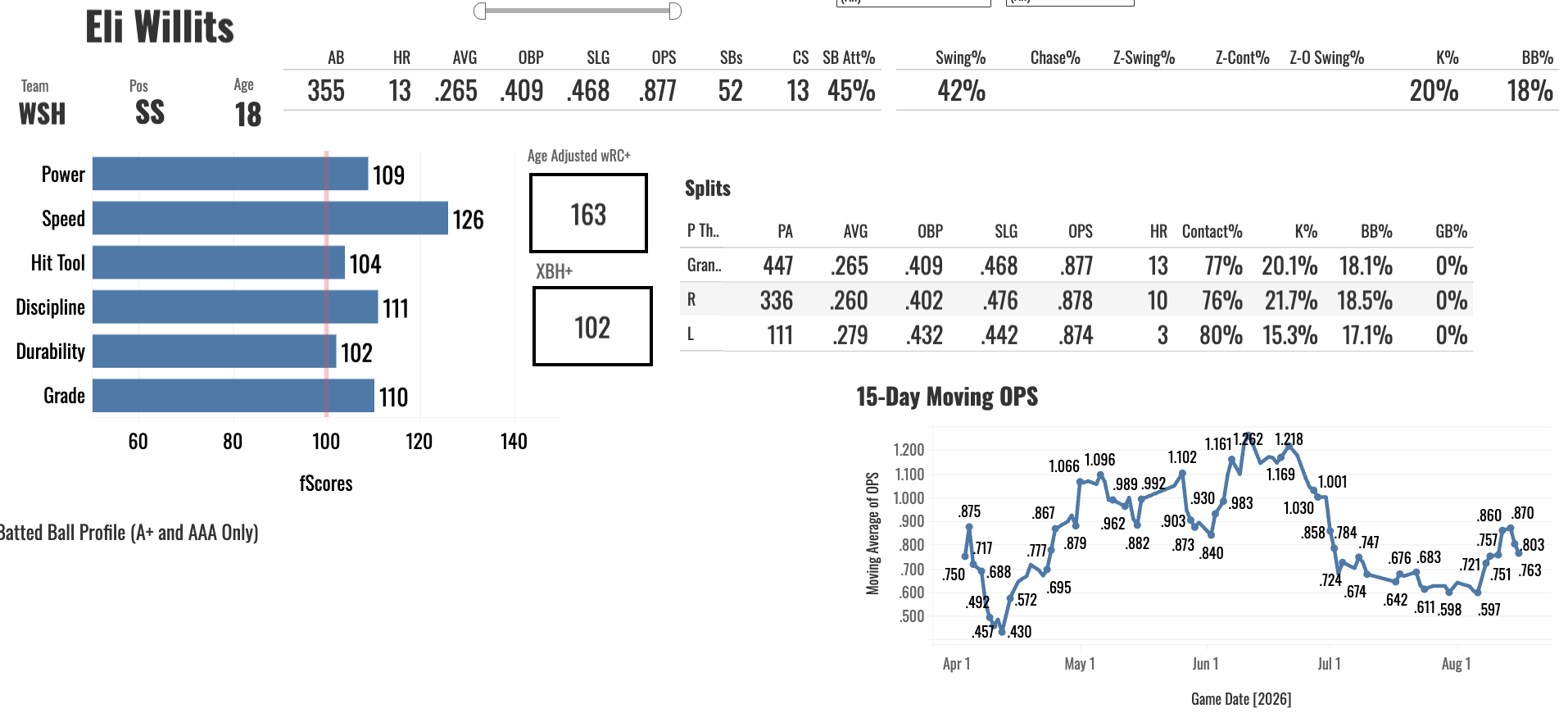
Previous Rank: 23 ETA: 2028 Comp: A bigger Jimmy Rollins type
Prime Skills: The number that should scare pitchers more than anything on Willits’ stat line is buried in the plate discipline data, not the box score: he’s simply not expanding the zone, and the in-zone swing rate on pitches he can do damage on is climbing at the same time. That’s the textbook signature of a hit tool that’s ahead of the level rather than getting by on aggression alone. I saw him personally handle Liam Doyle, Tanner Franklin and Yhoiker Fajardo at Spring Breakout, all advanced arms, and he didn’t look like an 18-year-old facing them, hitting leadoff and getting the barrel to spin-heavy stuff he shouldn’t have recognized that well yet. Since the High-A promotion he’s got six homers and nine steals in fewer than 30 games, and the average dip is entirely a BABIP story, the underlying zone-contact rate hasn’t budged. Power remains almost entirely projection, we don’t have public exit-velo readings on him since 2024, so I won’t pretend a number exists that doesn’t, but 41 extra-base hits in 94 total games this year, including a six-extra-base-hit, four-homer week right after the promotion, says the pull-air angle is starting to arrive alongside the bat-to-ball skill that never left.
Hitter Tool Grades:
• Hit: 45/60
• Plate Approach: 45/60
• Power: 40/55
• Speed: 65/65
Ranking Explanation: Willits is the kind of prospect who makes rankings articles boring in the best possible way, no viral moments, no swing-change sagas, just a switch-hitter who controls the zone like he’s been doing it since the Truman administration. The touchstone here is a JJ Wetherholt-lite profile with less thump, and I mean that as a real compliment: bat-to-ball skills this advanced at 18 don’t need power to be dangerous. What separates him from Clark and everyone stacked below him is simple: the hit tool and approach are already grading out ahead of players two and three years his senior, and that gap is currently bigger than the gap separating him from De Vries above him. Power is the only unfinished business, and I’d bet on a kid this disciplined figuring that out too.
5. OF Josue De Paula (Dodgers) - AA
Previous Rank: 14 ETA: Mid/Late 2027 Comp: A lefty Jordan Walker
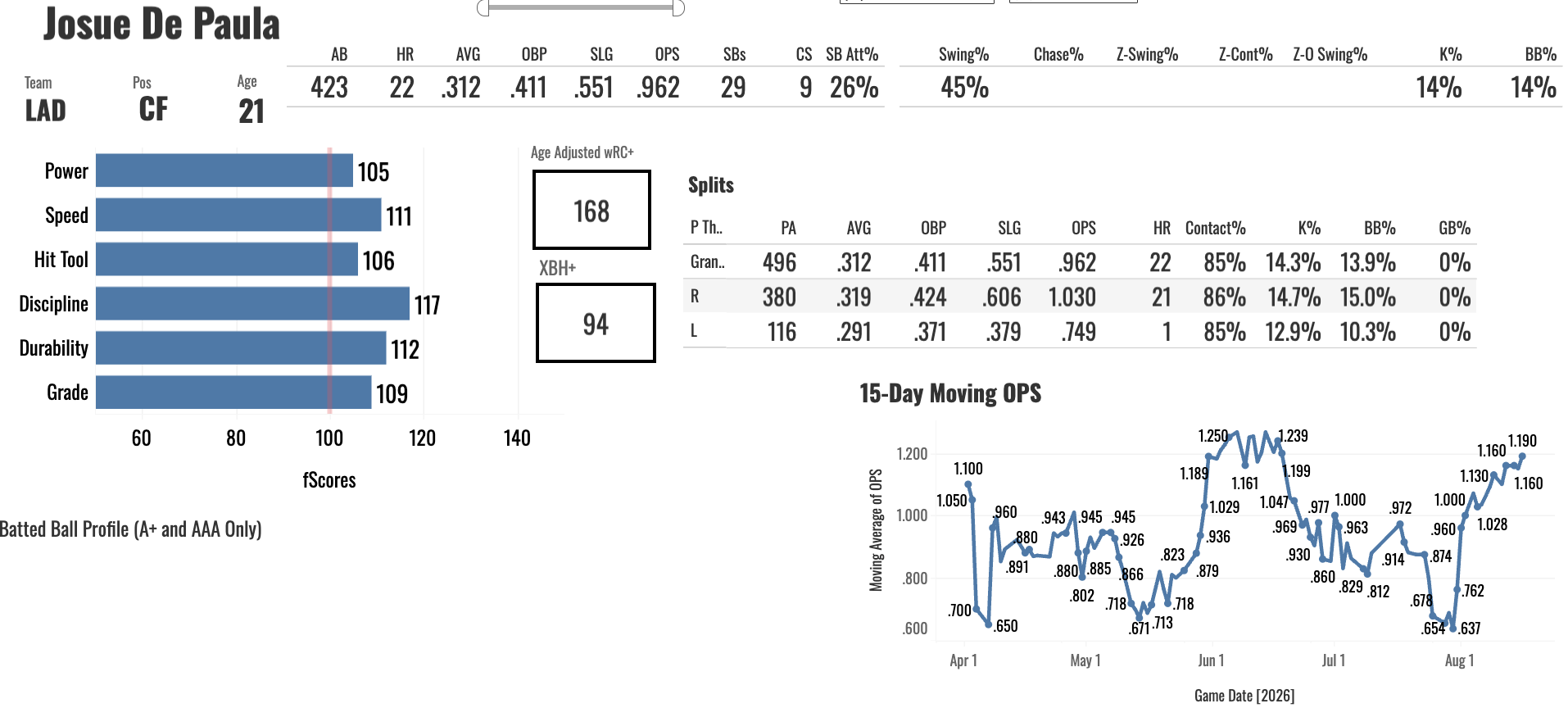
Prime Skills: De Paula’s entire profile turned on one swing-mechanics fix, and the numbers prove it wasn’t cosmetic. He’s swinging roughly 5% more often than he was in his conservative 2025 approach, and critically, the extra aggression came paired with a real ground-ball-to-fly-ball shift, not just more contact of the same old shape. That’s the difference between a hitter simply chasing more and a hitter who fixed his swing path and is now comfortable letting it rip. The stolen-base marks with a strong success rate, are a legitimately added tool for a player this physically imposing, not empty volume, the underlying sprint numbers back up real aggressiveness rather than just green lights from a coaching staff being generous. A .962 OPS at Double-A this deep into the fix, rather than a two-week hot streak, is what convinces me the ground-ball problem that defined his first two pro seasons is actually gone rather than dormant, while he was already getting to plus exit velocities last season.
Hitter Tool Grades:
• Hit: 55/65
• Plate Approach: 60/65
• Power: 50/65
• Speed: 55/55
Ranking Explanation: De Paula solved his own homework assignment this year. I wrote in the preseason that his conservative, contact-only approach was capping a frame built for real thump, he needed to simply swing more. He’s now swinging 5% more often and the ground-ball rate that defined his first two pro seasons has genuinely reversed, not regressed toward the mean, reversed. A .966 OPS with 22 homers and 29 steals at Double-A isn’t a hot streak riding shaky peripherals, it’s a swing change that stuck. He rates ahead of Clark for one specific reason: Clark has not fixed anything structural yet, he’s succeeding on the tools he arrived with, while De Paula rebuilt something and the results followed - that’s the more repeatable kind of breakout. There’s a good argument De Paula could be the #3 prospect ahead of De Vries and Willits and I wouldn’t argue it based on the higher power upside, however position matters and they’re both starting at a premium SS advantage without the concerns of getting blocked by a bloated system.