


Best Ball has really gotten popular in the last few years. It’s the perfect game for people who like to draft a bunch of teams, but don’t want to manage them during the season.
Let me start by saying I am not an Underdog partner. I’m not a schill, guys. And that’s not because of some principled stand, it’s just that all of these site partnership models are cost per acquisition, which means the money isn’t worth me constantly asking people to sign up with my code. But let’s just pretend that I’m making a very principled stand.
It’s a great format, though, and I know a ton of you play it. So I’m here to do what I can to help.
Some of the below came from a friend of the site, Dustin Jennings. Follow him on X.
BASICS
If you already know how this works, skip ahead to the strategy section.
TEAM BUILDING & MANAGEMENT
It’s really simple. You draft your team, and you’re done. And the positions are made very simple as well. You have pitchers, infielders, and outfielders.
SCORING SYSTEM
There are twelve teams in a league. You compete against those other eleven teams during the “regular season”. This is where things get different from other fantasy formats you’re used to.
Your team is scored weekly. All of your players accrue points through the week based on what they did in real life, and at the end of the week, the system automatically selects your best lineup for you. That is the “best ball” aspect. I think it’s a golf term, right? Where you’re on a team, but you only use the production of the best players on a given shot.
From weeks 1-18, you’re against the teams in your league. If you finish in the top two of your league, you advance to the next round. You’re put into a new (smaller) league, and you play against them for two weeks. You have to win that eight-man league over two weeks to advance to the third round. You do the same thing (nine-man league in round three) one more time, and the winners of those leagues advance to a two-week, one-league championship with 217 total entries.
I’ve broken it down in this table:
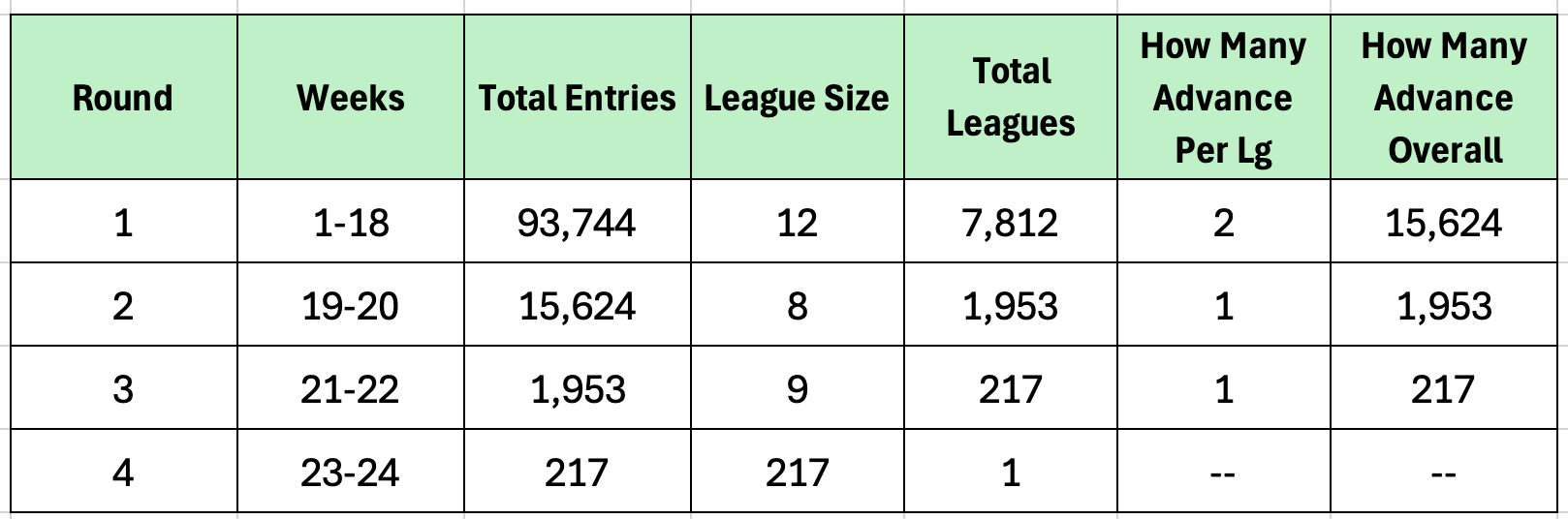
So it’s an elimination-style contest. It trims the competition from 93,744 teams to 15,625 teams to 1,953 teams to 217 teams to one winning team. The top prize is $200K, but if you finish in the top one-sixth of the competition, you at least get your money back (meaning if you advance from the first round, you get that entry fee back).
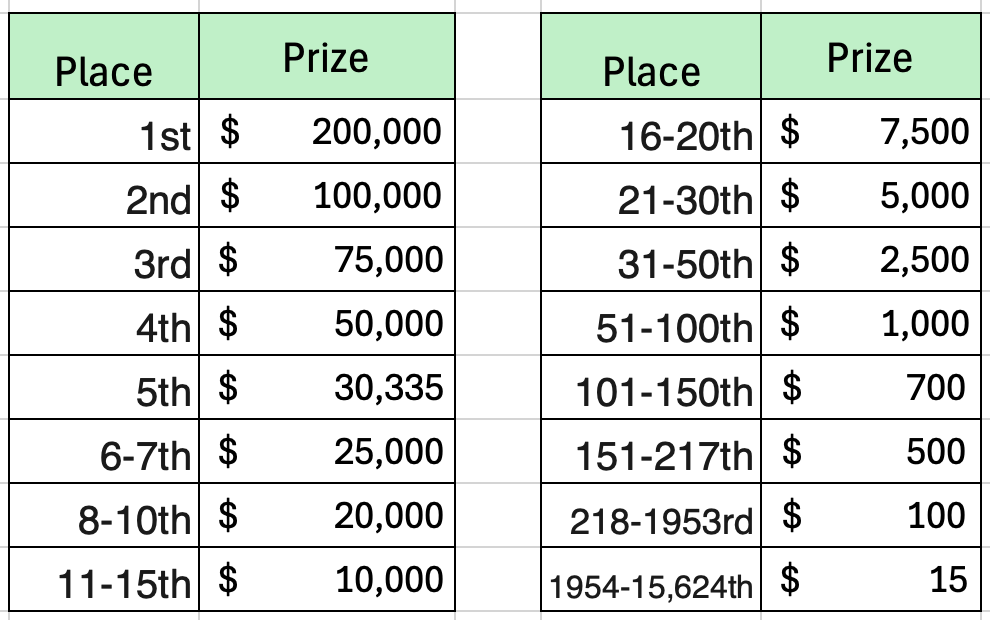
This is all specific to The Dinger, which is a $15 entry. There are smaller entry fee contests, though, that follow the same structure.
STRATEGY
Admittedly, I’m no expert on this. I’ve done very few, and haven’t even drafted one this year myself. But we can be logical here and think through it.
You’ll have a 20-man roster. And each week, only half of those players will count to your score.
3 pitchers
3 infielders
3 outfielders
1 flex (IF or OF)
So you sum up your three best pitcher scores and your seven best pitcher scores, and that score gets added to your total for the season. After week 18, the top two scores move on.
CONSIDER UPSIDE
That structure, plus the fact that the prizes are crazy top-heavy (14% of the money goes to the winner, 30% of it goes to the top four) means you want to build for UPSIDE. If you want the $200K, you have to beat 93,743 other teams. So it’s probably not going to happen, but if you want any chance at all, you have to find those later-round dudes who have monster seasons.
There’s a 150-entry max per user. And plenty of people will use all 150 of those. And they’ll have a huge advantage, obviously. Not only do they just have more teams with a small chance to win, they can also draft in a very specific way that gives them a better chance to hit the nuts. If you want to win the thing, as with any big DFS tournament, you’re going to want to put a ton of entries into the thing and be smart with how you build the teams as a whole.
CONSIDER STACKING
For 18 weeks, your goal will just be to finish 1st or 2nd in your 12-team league. You have a 17% chance at that, and a lot greater than that if you’re drafting smart. The boring, safe, value picks will help you advance. It’s when you get into these two-week sprints where you want to have teams that correlate well with each other and have a ton of high-upside players.
So it’s a balancing act. You want to go for a high advance rate (meaning drafting solid, balanced teams), but you don’t want to do that in a way that gives you no real shot at busting off for a six-week span where your team is going nuts.
Stacking becomes pretty important in those final weeks. Stacking (hitters from the same team) is great DFS strategy because players correlate together. I wrote this DFS strategy guide a couple of years ago, and it holds up well today:

The most valuable piece of information in that is the lineup spot correlations:

This compares scoring from each lineup spot with every other lineup spot and looks for correlations. The highest is the 3rd-4th correlation. If the #3 hitter has a big game, the #4 hitter is more likely to have done the same, and vice-versa. The lowest correlation is the #6 hitter and the #9 hitter, which makes sense. They’re far away from each other in the lineup and will almost never both hit in the first inning. The first inning is where most of these correlations come from.
That stuff is less useful in Best Ball, because it’s a two-week period at minimum, rather than just one day. Those correlations will shrink substantially when you’re looking at a two-week period.
But it still makes sense to put some guys together from the same team. You’re trying to shoot the moon. So maybe you want to build some teams with a stack that will show up together playing in Coors Field during the final two weeks. You’d be feeling pretty good about your chances among the 217 remaining teams if you have four hitters heading into Coors Field against that pitching staff at the end of the season. This year, the final round is from 8/31 to 9/13. The Orioles and Cardinals both play three games there in that first week.
Does that mean you should seriously upgrade O’s bats? Probably not. You’d first have to actually make it to the final for it to even matter, and even then, it’s three games. You never know how an individual series will go, and you don’t know what the Orioles lineup will even look like by September.
But those types of things are small edges to consider building in when you’re putting together a bunch of teams.
POSITION CONSIDERATIONS
It doesn’t look too weighted this year. 55 of my top 100 hitters are infielders. So that’s a 55%-45% split in favor of infielders over outfielders. That is logical since we have five infield positions (although catchers hardly count since most of them don’t play a ton) and three outfield positions taking the field in real life. In the early rounds, break your ties by taking the outfielder.
The ADP data also seems very beatable on the pitching side. There are a ton of pitchers to like. You also only need three pitchers per week, and a lot of who is chosen each week will be based on who has the two-start week. You still want the better pitchers, of course, but there’s something to be said for building up a roster full of pitchers you think can stay healthy and make a start or two every week for you, and then just kinda hoping for two-start variance to go your way in the final two weeks.
THAT SAID… the Chase Burns type is appealing here. We’re not sure if he can throw 160 innings in the Majors this year, but if he’s healthy in September, you have a chance for some of those 10+ strikeout games when it matters the most.
I’d build up a mixture of safety and upside arms, while leaning a bit more toward the safety options. Personally, I’d be building for the 18 weeks rather than the six weeks of playoffs. Target a high advance rate and hope for the best. This is all pretty much a lottery-type crapshoot in the end.
I’ll leave the strategy part there. There are many other places to read about Best Ball strategy, and most of them do a better job than me, probably.
MLB DW Resources
Here’s me doing the thing I’m actually good at. We have an Underdog Draft Buddy! Paid subs will have access to it, you can find the link in the Resource Glossary and below the paywall here.
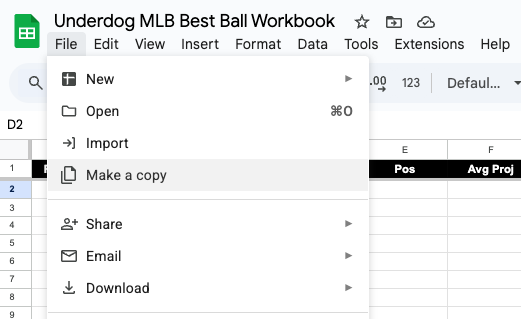
Open up the sheet, and make a copy:
Start typing in your draft results in the “Draft” tab:
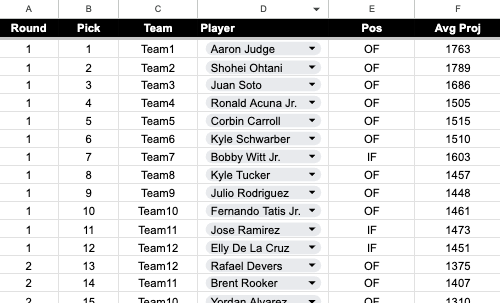
You will be given the average Underdog projection across four projection systems:
MLB DW
OOPSY
ATC
THE BAT X
There’s a tracker in there to show your projected total and the number of players at each position you’ve taken:
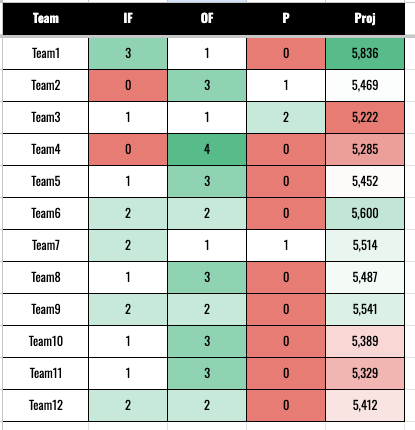
Go to the Projection2 tab:
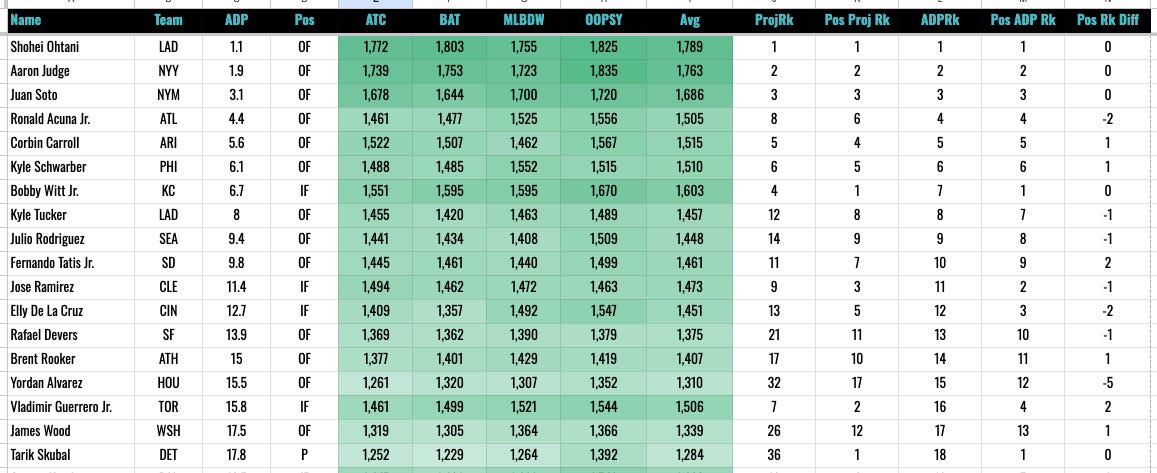
There you’ll see the projections for each system and the average. You’ll also see the ADP ranks compared with the projected rank, and there are columns there that break that down by position.
So you can set the Avail? column to Y, and then sort by projection, and see the best available players:
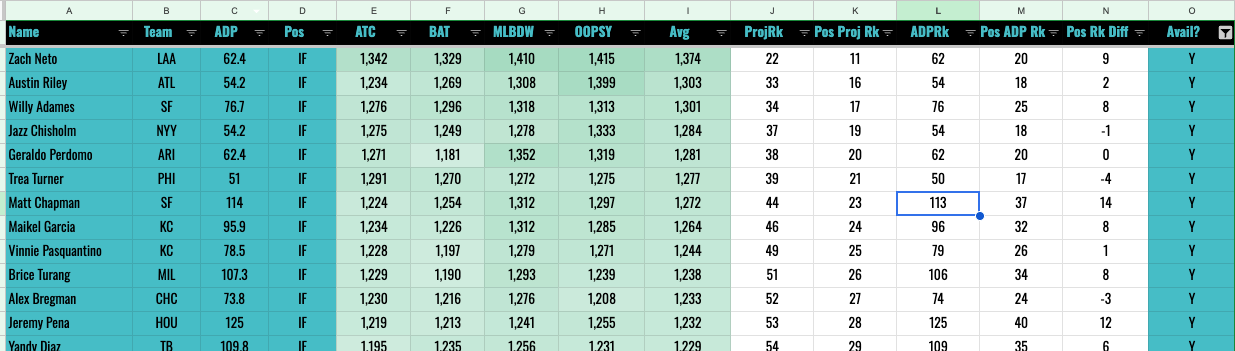
You can sort by whatever projection system you want, and the Underdog ADP is there to give you an idea about when it’s time to pull the trigger on a guy.
Projection-Based Targets
Relative to ADP
The ten pitchers highest above their ADP with what we’re projecting (filtered to guys I myself like):
Jose Soriano
Merrill Kelly
Zac Gallen
Yusei Kikuchi
Jack Flaherty
Mitch Keller
Tanner Bibee
Matthew Boyd
Love all of those guys at these Underdog prices.
Infielders:
Bryson Stott
Ezequiel Tovar
Bryson Stott
Ivan Herrera
Xander Bogaerts
Zach Neto
Maikel Garcia
Caleb Durbin (last round?)
It seems like drafters prefer the home runs, and you can get some nice value on these guys who pile up base hits and steals.
Outfielders:
Heliot Ramos
Bryan Reynolds
Jo Adell
Ramon Laureano
Jordan Beck
Andy Pages
Brenton Doyle
Matt Wallner
Daulton Varsho
Projection-Based Fades
Relative to ADP
Pitchers:
Roki Sasaki
Cam Schlittler
Zack Wheeler
Gerrit Cole
Cade Horton
Bubba Chandler
Nolan McLean
Chase Burns
Shane Bieber
Trey Yesavage
There’s a bias toward the young players, and that makes sense, since those guys make more sense as potential projection-beaters. But in reality, we see veterans have the huge breakout season just as much, if not more, than the rookies. So I wouldn’t be putting too many chips on the young guys like the field is doing. But that’s not to say avoid the high-risk, high-reward players altogether.
Infielders:
Konnor Griffin
I get it for the late-season appeal, but he’s unlikely to help you advance
Max Muncy
Spencer Steer
Isaac Paredes
Addison Barger
Jackson Holliday
Sal Stewart
Outfielders
Jasson Dominguez
Nick Castellanos
Jac Caglianone
Anthony Santander
Chase DeLauter
Chandler Simpson
Tyler Soderstrom