

I heard a stat that only 4% of the US adult population is paying for an AI service. The person who was talking about it was appalled at the number. He thought it should be way higher. And it should be higher. This stuff is all still pretty much brand new, and it takes a long time to get a large percentage of people on your product, no matter what it is.
But should your grandma be using AI? Should someone who has done just fine in their life without being on the cutting edge of technology (or even using a PC during an average day) transform themselves to pay $20 for Claude Code to… do whatever?
There are certainly ways it can help pretty much any sort of person, but I think the importance of AI in the individual’s life has been overstated. Mind you, I’m talking about paying for AI. You cannot make a Google search anymore without using AI, so in that way, everybody uses it.
That brings me to my actual point. People trying to do the stuff I do here should be using it, but they should be using it in a smart way.
What you could do right now is go to ChatGPT or Claude or Grok and tell it to project the World Series. It might ask you for some data or ask you some questions, or it might not, but it would complete the task and give you a nice-looking page of projections. It will be extremely confident; you’ll think you had something. And the result today is going to be better than what the result would have been a year ago. But it’s still not a good projection until you prompt the thing in a smart way.
MLB DW projections have been completely AI-free. That’s a point of pride for me, not because I think I’m better than an AI-assisted situation, but that I was able to do them before the help became available. I spent dozens of hours coding and testing my models and refining them over several years to get something good. I’m proud of that.
But no doubt I will be taking that code and seeing how AI can strengthen it ahead of next year.
And this is the point. The more effective users of AI will be the people who can do some of this stuff without it. People like me understand (generally) how this stuff works, where it can fall short, how to prompt, what data to provide, etc. Those are the people getting the most out of it.
So I have some advice for those of you without that kind of background who want to build some stuff with the tools available to you now. Do it! There are plenty of people like me out there who are really angry that Joe Schmo can now compete with them, but that’s not me. It probably has cost me some customers since people can replicate the stuff I’ve done on their own, but I’m not one to get mad about stuff I can’t control. And every dollar I have past the amount I need to live comfortably and freely with my family is a dollar I don’t need.
Back to my advice, though. Learn the basics, understand the data. Think through everything first before you start building. If you have the core understanding of what you want, the data you have, and the process of turning it into a product - you’ll go way further. And guess what, the AI itself can help you do that. Tell Claude to get the 2026 pitch-by-pitch Statcast data for you, and have it walk you through the columns you don’t understand. Have it build you a wOBA vs. xwOBA report. If you don’t know exactly what xwOBA is, ask the thing - it’ll tell you. Tell it to explain it to you like you’re seven - seriously. The limits of what you can learn just sitting on your computer in your basement are crazy high. Take advantage.
So here’s my use case, and here are some conclusions for you. My goal was to see if I could find any statistical combinations that predict next year’s breakout hitters. I extracted some FanGraphs data from 2021-2026 (split by year). I’m a paid member of theirs, as we all should be just to support that legendary baseball website, so I can do that! I fed it into ChatGPT (I pay for that and have the Codex desktop app, which takes everything to the next level) and went back and forth testing some things.
That’s where the foreknowledge helps. You could plop a bunch of data in there and just write “study this data and find me 2027 breakout hitters”. You’ll get results (it will always give you results), but it’ll be weaker than it could be.
I plugged in the last six years of STEAMER projections, too. I used those to define who the breakouts were. I targeted hitters that massively outperformed their projected fantasy projections (R, HR, RBI, SB, AVG, OPS) and called those “breakouts”. Then, after defining the breakouts, had the model see if it could find any common threads in the prior year’s stats for those breakouts. Does a certain combination of stats seem to show up more often? Did hitters with better plate discipline and higher EVs break out more often? Did a certain age break out more often? How important was each feature (aka statistic) in strengthening the prediction?
I iterated through that a bunch of times.
And you know what I found, generally? Not much, man! Computers do a lot in baseball, but they don’t play the game. Humans aren’t all that predictable. They’re more predictable when playing a well-defined game; sports are more easily predicted than, like… where your wife is going to tell you she wants to go to dinner tonight. But you get it - we cannot predict future human performance all that well.
A Losing Feature: Age
You’d think this would be a key feature. Logic suggests that a 23-year-old will break out the next year more often than a 32-year-old. But that’s only a little bit true.
Here’s the “breakout rate” by age table:
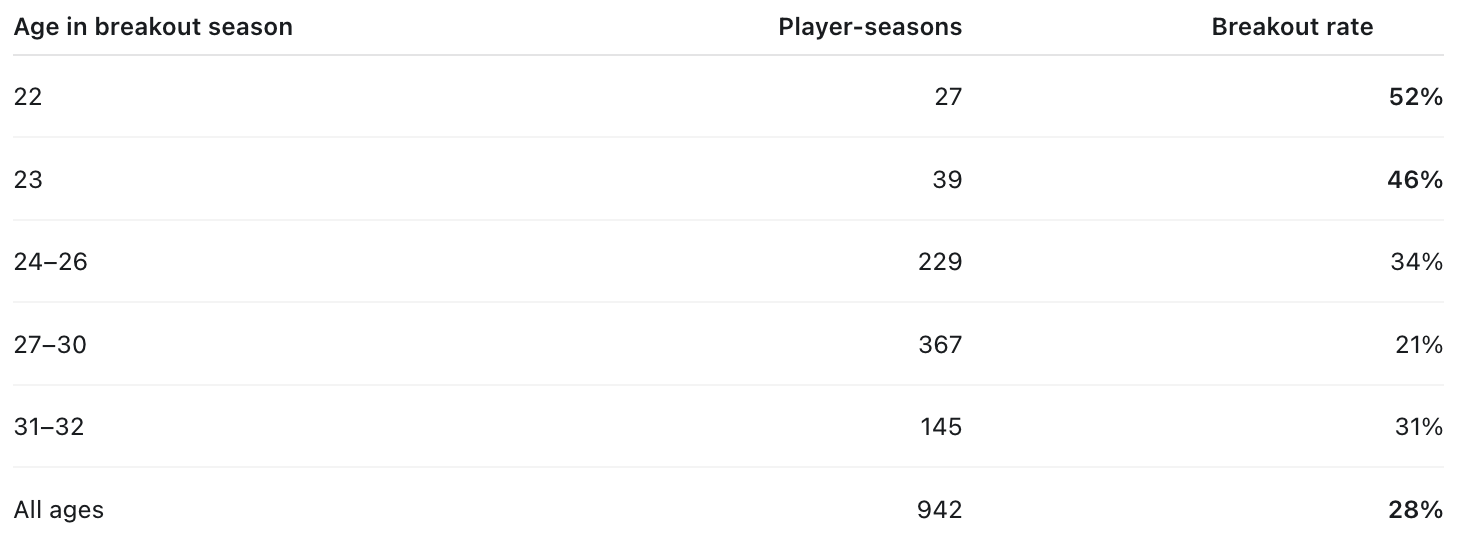
So yes, the guys under 24 year old broke out a lot more often than the older guys. But there are two things that make that true and make it not very useful to us in predicting next year.
The first, and biggest, thing here is survivorship bias. By the rules I set up, a breakout player had to see at least 400 PAs to even qualify for checking. And that’s a good way to go about it, because you have to play mostly a full year to really be a breakout for fantasy leagues. The 22-year-olds who played and received 400+ PAs did that because they were doing well enough to stay in the big leagues. A ton of young guys come up at this age, suck, and go back to the minors. So guess what - they’re not in the denominator of that 52% breakout rate. That 52% breakout rate for 22-year-olds says that 52% of the 22-year-olds who stayed in the lineup most of the year broke out. NO KIDDING! They stayed in the lineup because they were breaking out; the kids who weren’t breaking out just went back to the minors and exited the study.
Secondly, projections are always going to be pretty low on new players. Most minor leaguers that enter the big leagues stink at first, so projections factor that in. So it’s not all that hard for a 23-year-old to beat his projection, because the projection was weak in the first place.
What Might Work
I really thought I might find something to hit a home run with. But I was overconfident. The most useful features in predicting next year’s breakouts were our old friends, xBA and xSLG.
Hitters who had higher expected stats than their actual stats broke out more often the next year. Remember, I used STEAMER, one of the older projection models. So this might be STEAMER just using too much of AVG/SLG rather than the expected numbers.
I don’t even use STEAMER in my own research; I opt more for ATC and The Bat X. I chose STEAMER cause they’re always out first, and I think they’re more widely cited/used by the field. But I could be wrong about that.
But it’s a good start. We know that xBA and xSLG are more predictive of the future than AVG and SLG. It’s October 2026; we’re a long way from next year, so let’s just have some fun.
Let’s look at xSLG-SLG differentials from last year.
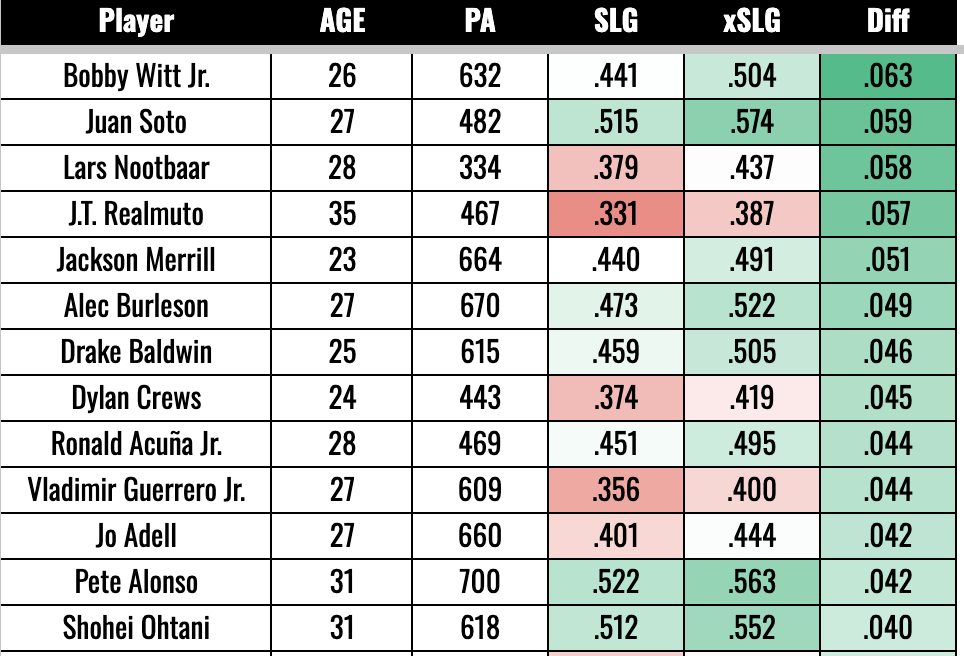
13 names with +40 points or more on xSLG compared to SLG. Witt, Soto, and Ohtani are here. But they’ll be top six picks next year. Yes, you can draft them confidently. They might even play a spot or two above where you drafted them, but they’re not really “breakout” candidates for fantasy leagues.
So let’s get to the names you November-drafting NFBC sickos might be interested in.
Lars Nootbaar
.379 SLG
.437 xSLG
I’ll get the NFBC ADP dashboard going in November when they roll over to the next season. But for now, I’ve got nothing. But I know for sure that Nootbaar won’t be expensive.
I tend to like guys who switch teams as candidates for bigger changes the next year. The park thing is obvious. Different orgs have different approaches. We’ve seen what the Rays did with Freddy Peralta this postseason. That stuff is probably easier to pull off with pitchers than with hitters, but it’s not impossible that the Diamondbacks just saw something with Nootbaar and fixed it.
With STL: .234/.330/.354, 22% K%, 12.6% BB%, .241 xBA, .332 xwOBA
With ARI: .244/.342/.409, 20% K%, 13.4% BB%, .254 xBA, .355 xwOBA
He improved in every category with Arizona. He pulled it in the air way more (7.6% → 16.2%), he made more contact, he hit the ball harder, his xStats went way up. He even swung a little bit more (36% → 39%).
The Noot will be back with the Diamondbacks for 2027 before becoming a free agent. To me, it seems like something changed in the approach. The air pull alone kinda tells me that. The K% and slash line could be noisy in just a two-month sample, but that kind of change in air-pull rate is very unlikely to be random. And he’s always been a decent EV guy. 106.3 EV90 last year, 106.3 on fly balls. He has power. An approach change made a lot of sense, and the D’Backs might have a breakout on their hands in 2027.
More breakouts behind the paywall! Sign up today to get the rest of this post and all of the rest of the NFL and MLB content coming all the time!