

Every passing year puts more Statcast data online for the masses. I’ve been slow to get on board with the new stuff. Which you wouldn’t think I would be, right? This is MLB DATA WAREHOUSE. “Data” is in the freaking title. Maybe I’m just lazy, maybe I’m inflexible. Probably both of those things. I’m not too into the new shiny new toy thing. Especially with stuff like this that seems more “fun” than “predictive”. But how would I even know until I look?
So I’ve gotten into attack angle and attack direction a bit more this weekend. It’s really cool stuff, if nothing else. The nerds and physicists (but I repeat myself) can have a lot of fun with that interactive tool they have.
It does help you immediately understand why Vlad Guerrero Jr. doesn’t hit many homers. You could figure this out just by seeing his launch angle stuff and high ground ball rates. But this takes you a step forward and shows that his ground balls aren’t just coming from mishit balls (off the lower part of the barrel); they’re coming from his swing path:
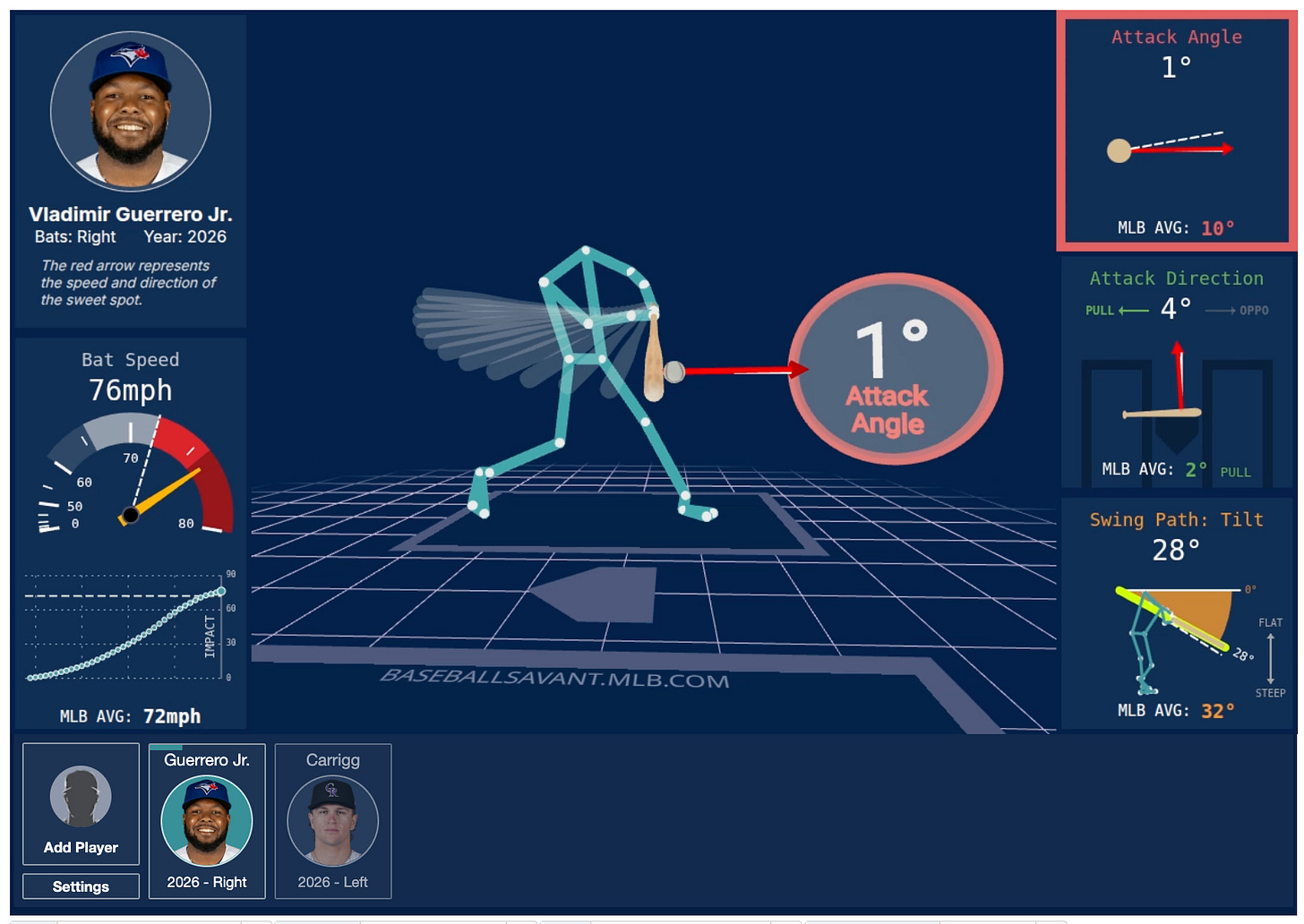
He swings mighty hard and hits it on the sweet spot of the barrel all of the time, but with the path of the bat being what it is, you’re going to get a lot of balls that hit the ground before getting through the infield.
So what I figured I’d do is model home run rates with the characteristics of the swing. I used these:
- Bat Speed
- Attack angle
- Attack direction
- Zone Contact%
The contact rate portion of that isn’t just about the swing. But I wanted do try to avoid getting a list of players who swing for the fences in a fine way, but don’t time it up with the pitch and end up whiffing so often that they can’t rack up dingers.
We get a result like this:

It may be overly simplistic, and that turns into some huge disparities in the predictions vs. the actual results. I left out walk rate, for one, which does make a difference since our target home run rate is home runs divided by plate appearances, and every walk is one plate appearance you didn’t hit a homer in.
But I’m not putting this post up for any academic rewards! And I think this gives us a decent feel for guys with big home run upside that didn’t come through on it in 2027.
Backtesting it on 2026 was a success. If we ran the same thing a year ago, here are the guys we’d have been on for the season that just finished:
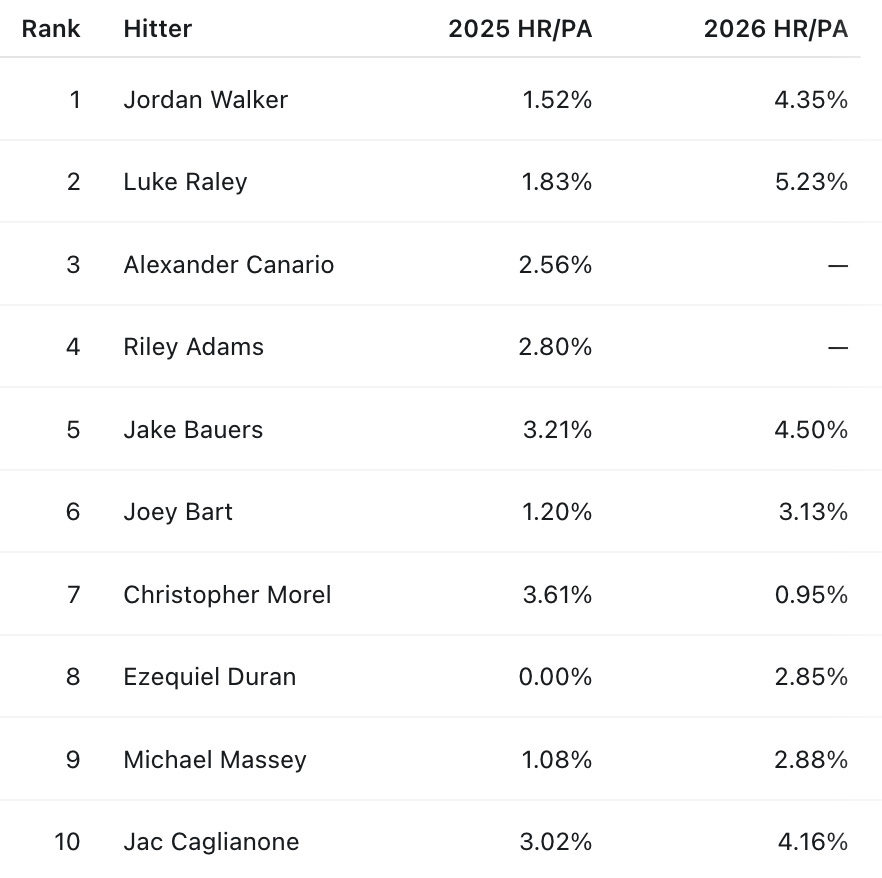
Canario and Adams didn’t play enough to qualify, but seven of the eight remaining hitters did significantly increase their home run rates. So that should get you interested in reading the rest of this!
So we’re looking at the hitters that have those types of swings but came in with lower home run rates last year. Rates that could improve next year with slight improvements and more “luck”.
Riley Greene, Tigers
His +16 in the total home run differential made me question this whole idea. But when you look at the numbers, you see that it’s pretty shocking that he only hit 21 homers last year. He jammed 36 dingers in 2025 for a 5.5% HR%. And then just a 3.5% HR% last year, his worst by far since 2023 when he was still a young pup (or whatever the word is for a baby Tiger, I guess).
His attack angle is one of the highest in the game at 17 degrees. It’s an uppercut swing with a whole bunch of velocity in there.
He actually improved his strikeout rate last year, down to 26.5% from 30.7% in 2025. He walked way more (+5 points), so that took away some opportunities, but he kept on barreling it at a high rate (14.8%) and hit his fly balls mighty hard (106.9 EV90).
But just a 36% HR/Brl rate. That’s very low. The home park has a part in that, but the main culprit is probably that he hit 53% of his barrels to center field. That’s not what you want to see, but it also means that if he was contacting the ball just a little bit further up, a lot of those deep doubles or fly outs to center/left-center would go further into right field and find the seats that are closer to the plate.
And hey, he hit 15 fewer homers in 2026 than in 2025! So our +16 is kinda right on the money in this model.
Riley Greene has some of the best raw power in the game, and I think he’s in for another 30+ homer season coming up.
Garrett Mitchell, Brewers
Dedicated a whole post title to this dude recently, check that out.
The guy is the man. One of the most talented athletes in the game. Tons of bat speed. But a lower-than-ideal attack angle at 10 degrees. 56% of his batted balls were ground balls. That seems really high for a 10 degree attack, but maybe pitchers just kinda knew where to throw him pitches to avoid the power stroke.
That’s a part of this too, right? The pitchers are in control. They can throw pitches that you simply cannot hit a long way. Home runs come on mistakes, not on great pitches.
Mitchell converted just 31% of his barrels into homers. So that takes away the ground balls entirely. But again, 66% of his barrels went to centerfield. Same “problem” as Greene. And maybe that will be the theme of this post.
I put problem in quotes because a barrel to centerfield is still a great outcome. Those go for extra bases a lot, but most of those screaming barreled outs are ones hit to center field where there’s more room for the other team’s best outfielder to go make a play.
To me, though, it signals that Mitchell and company are one tweak away from pulling more barrels and hitting a bunch more homers.
Mitchell posted a 3.6% HR% in 2024 (69 games), and has been around 2% the last two years in limited time on the field. He’s never stayed healthy, which mutes the whole conversation. Can’t hit 25 bombs next year if he only plays 90 games again. But I don’t need to say it any more times - Garrett Mitchell has loads of upside for offensive production. And I’ll be buying next year, once again. We’re just a healthy season and a few tweaks away from this guy going 30-20.
Jo Adell, Guardians
A huge 6.5 HR% in 2025, and then it fell to 3.5% this year. One of the bigger drop-offs you’ll find.
He has no trouble with bat speed, he’s always been near the top of that leaderboard. His attack angle is right with Mitchell at 10 degrees. Which isn’t concerningly low, but the ideal spot seems to be closer to 15 degrees.
Adell switched teams, which could help him. Going from the Angels to the Guardians is an organizational/analytical upgrade, we think.
He’s had big strikeout problems in the past, but his 83% Zone Contact% was very good in 2026. He struck out just 24% of the time!
But the power numbers weren’t great. Only an 8.6% Brl% after a 17% season in 2025. What’s the next logical number in the sequence of 17% → 9%? In baseball, it’s probably like 12%. Closer to the most recent number, but somewhere between the two “extremes”.
I’m excited about Adell as a power hitter once again next year. The bad news is that the steals have gone away. He looked like a 30-30 dude coming up, but he’s slowed his role on the bases. This is another thing that the Guardians could push upward, though, right? They’re a steals-heavy team, usually. That’s more about their roster than their philosophy, but not entirely so, I don’t think. The Guardians attempted steals at an 11.8% rate, while the Angels were at 8.2%. I don’t think it’s crazy that a guy with speed like Adell could get up to 8-10 steals again next year.
He’s certainly a physical talent worth betting on.
More hitters below the paywall!
Zach Neto, Angels
The highest attack angle in the game. Maybe too high at 20 degrees.
- Neto 20°
- Murakami 19°
- Suarez 18°
- Manzardo 18°
- Carpenter 18°
This is a massive uppercut swing. That turns into a 36% FB%, which is good, but often leads to balls hit too high to be home run contenders. His 11.9% Brl% is good, but not among the elites, and his bat speed and EVs are well shy of the best in the league as well.
But there’s a reason that Neto has hit 23, 26, and 27 homers in his last three seasons. He gets the ball in the air and pulls it a ton. That gets him homers, and it’s not going to stop now.
The downside with this kind of swing is whiffs. A flat swing is in the hitting zone more, while a swing angled way up has less time in space to contact the ball. But it’s a trade-off that can work. It’s not a good or a bad thing by itself.
Neto hit those 27 bombs last year, a career-high even with a career-high 30.5% K%. There could be some regression down toward his career average there, which would be great. And he’s still just 25 years old as I write this. Without massive bat speed or EVs, he has a lower ceiling on the home run total than other guys, but I think we could see him get to 30+ bombs and 20+ steals next year pretty easily.
Cam Smith, Astros
Will I write a breakout article this year that doesn’t have Smith in it? I’m not even forcing it in this case, he’s just next in the data.
Most of the big home run prediction comes from his bat speed, which is elite. His attack angle is, again, at 10 degrees. Which is fine, as we’ve said.
His strikeout rate has been 26.5% in his big league career, which is also perfectly acceptable.
The next step for him will be becoming a little more selective in the pitches he swings at and pulling more of them. He chased a good bit, and pulled just 39% of his barrels for a 49% conversion rate. That’s about the league average, but you’d expect a higher than average rate for someone swinging the bat this hard.
I’m on Cam Smith bigly for 2027. Bet on the tools!
Austin Riley, Braves
12.2% Brl%, lots of fly balls, strong bat speed, but too many whiffs in a very frustrating year.
His attack angle was 11 degrees, his zone contact rate wasn’t great, but not a huge problem. He just didn’t get the job done for whatever reason. The six-year high in K% (32%) was certainly a big part of it. But the guy still has a power swing, and he’s still under the age of 30.
I bought low last year, and it failed. But we can buy even lower in 2027. This was his first time ever below a 4.0% HR%, and it went all the way down to 3.0%. There’s positive regression for Riley that is likely, and I’m willing to try it again.
Kevin McGonigle, Tigers
Not a name I expected to come across in this one, but what a great sign it is for the AL Rookie of the Year.
Not a ton of bat speed or EV on McGonigle (102.5 EV90, 109.5 max). But the attack angle of 15.4 degrees gets the ball into the air, and he did a decent job of pulling it (15.3% Air Pull%). 38% of his barrels went for homers, which is about ten points below the average. That’s probably because of his lack of upper-tier EVs, but the 22 year old has a lot of time to grow into more power.
He hit 18 homers, but he modeled here at 28. I don’t think that’s realistic for next year. He’s not a big dude and the bat speed is low, but with a full year under his belt and all of the raw talent he has, we expect him to get better and better.
We saw a huge power breakout in his minor league season in 2025. He went from a 1.5% HR% in 2024 to 4.8% in 2025. It was just 2.5% in his rookie season in the bigs; I think that can grow get above 3%. We’re looking at a mid-20s homer season from McGonigle next year, and he’s already got the great batting average (.278) and elite OBP (.376) figured out. Add in 12-15 steals and you could have a 25-15-.280-.375 season. Pretty nice!
Brett Baty, Mets
Baty’s never had much trouble with exit velo. He looked like a developing power stud coming up through the minors, but it hasn’t happened for him yet in The Show.
The bat speed is no problem, and he ramped up the EV to 114 - a very high number. His attack angle is solid at 11 degrees.
However, he hit .175/.275/.225 against lefties last year. So he’s going to have trouble there, and he’s best used in a platoon. I’d still be buying low in your dynasty leagues, because he’s likely going to do much better than the 2.3% HR% that turned into just 11 homers in 143 games last year.
Royce Lewis, Twins
125 games played for Lewis in 2026! That was a big win in and of itself after his checkered injury past. He hit just .227/.287/.380 last year with a few massive cold streaks. But the guy quietly hit 15 bombs and stole 16 bags.
The swing is built to be a 20-homer guy. High bat speed, 11.4 degree attack angle, and a very high 24% Air Pull%.
Maybe he’s kicked the injury bug (or not…), and a fully healthy offseason and spring training could help him take the next step and be a 20+ homer guy next year for the Twins.
Here’s the data sheet if you want to dig into a lot more players.
But some more names that are of interest to me that I won’t get into the details on:
Others:
- Colson Montgomery
- Kyle Stowers
- Vlad Guerrero Jr.
- Julio Rodriguez
- Colton Cowser
- Konnor Griffin
The Other Side of Things
There are, of course, some names who hit for much higher HR% than this simple model would expect. Most of these guys aren’t names to worry about because they’ve done it so convincingly for so long. But here they are:
- Rafael Devers
- Pete Alonso
- Ben Rice
- Joc Pederson
- Matt Olson
- Randy Arozarena
- Mookie Betts
- Yordan Alvarez
- Hunter Goodman
Four of those guys (in bold) hit 40 bombs last year. You don’t hit 40 bombs without some things going your way. The correct projection is almost always going to be for regression on these huge seasons.
I really don’t think we’ll see Devers come near 37 bombs again in San Francisco. Pete Alonso… it’s hard to knock it since he does it every year, so I wouldn’t balk at him at all.
Ben Rice gets the ballpark boost, and he is just so good, but yeah - maybe 35 homers is the expectation rather than 40+.
I’ll leave the rest to you, the data is available. It will be interesting to look back on this one and see how it went.
Lots more data analysis to come as we work through this long, painful offseason ahead of 2027.-


